Tag: ai assistant

  • What Is Omnichannel Lead Management? A Plain Guide

    What Is Omnichannel Lead Management? A Plain Guide

    Omnichannel lead management means catching every customer conversation — WhatsApp, Messenger, Instagram, SMS, email in one place, instead of checking five separate apps and hoping nothing slips through. It’s the difference between a business that knows the moment someone reaches out, no matter which app they used, and one that finds out three days later that a lead went cold in an inbox nobody was watching.

    The term gets used loosely, so it’s worth being precise about what it actually involves — and what it doesn’t.
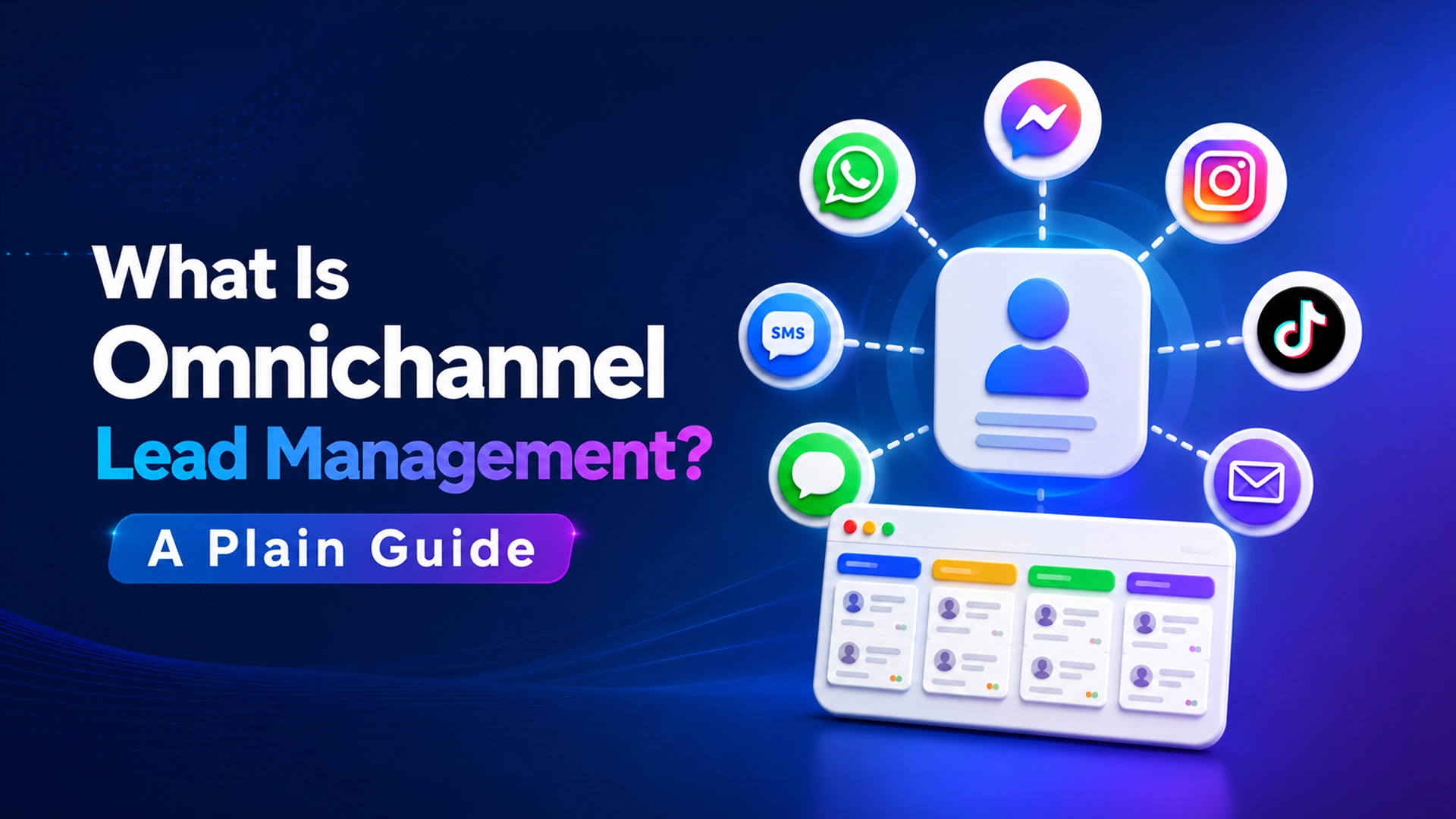
    What is omnichannel lead management, explained in plain terms
    Omnichannel lead management means one inbox and one history per customer, not five separate apps.

    What omnichannel lead management actually means

    It’s not the same as “multichannel.” A multichannel business has a Facebook Page, an Instagram account, and a WhatsApp number — three separate places customers can reach them, each checked separately, often by different people, with no shared record between them. Omnichannel means those three channels feed into one place, with one history per customer, regardless of which app they happened to message from.

    The practical test: if a customer messages you on Instagram today and follows up on WhatsApp tomorrow, does whoever answers the second message know about the first conversation? If yes, you have an omnichannel system. If no, you have several channels that happen to exist near each other.

    The core pieces of a real omnichannel lead management system

    1. A unified inbox. Every channel — WhatsApp, Messenger, Instagram, TikTok, SMS, email — lands in one threaded view, with the customer’s full history attached, so anyone on the team can pick up a conversation with context.
    2. An AI first responder, with a human handoff. Instant replies to the questions that repeat constantly — price, hours, availability — with a clean handoff to a person the moment the conversation needs real judgment, and a way for a human to take over at any point.
    3. A visual pipeline. Every conversation tagged by stage — new inquiry, qualified, negotiating, closed — so nothing depends on one person remembering where things stood.
    4. Broadcast and nurture tools. A way to re-engage people who went quiet, instead of losing them the moment they stop replying.
    5. Attribution. A line connecting the ad, campaign, or channel that brought the lead in, to whether it actually converted — not just how many clicks it got.

    Miss any one of these and the system tends to break down somewhere specific: no unified inbox means messages still get missed — research citing Salesforce found 90% of customers expect a reply to a social inquiry within ten minutes, while the average business takes over ten hours on Instagram alone; no AI-plus-handoff means either slow replies or a robotic chatbot that frustrates people; no pipeline means “who’s following up on this” becomes a guessing game; no attribution means marketing spend keeps flowing to whatever looks good on paper rather than what actually converts.

    Common omnichannel lead management misconceptions

    • “It’s just a chatbot.” A chatbot alone, with no human handoff and no pipeline behind it, tends to frustrate customers on anything beyond the simplest question. The AI piece only works well as part of a larger system.
    • “It’s the same as a help desk tool.” Help desk software is usually built for support tickets after a sale. Lead management is built for the conversation before a sale — qualifying, nurturing, and converting a prospect, not just resolving a complaint.
    • “More channels connected automatically means better coverage.” Connecting five channels to five separate inboxes that nobody consolidates doesn’t fix the underlying problem — it just adds more places for a message to get lost.

    Frequently asked questions

    Is omnichannel lead management only for large companies?

    No — the businesses that benefit most are often small teams, because they have the least slack to absorb a missed message. A single missed inquiry matters more to a five-person team than a five-hundred-person one.

    What’s the difference between omnichannel and multichannel?

    Multichannel means being present on several platforms, checked separately. Omnichannel means those platforms feed into one shared inbox and history, so no conversation depends on which app a customer happened to use.

    Do I need a human team if I have an AI assistant?

    Yes, for anything beyond routine questions. The AI’s job is to handle the repetitive first-contact questions instantly and hand off cleanly — not to replace a human for real qualifying conversations or judgment calls.

    How is this different across industries?

    The core system is the same, but the trigger and the stakes differ — see how it plays out specifically for real estate, healthcare, or e-commerce.

    Why this matters right now

    Customer communication has shifted from phone and email to chat across almost every industry we’ve looked at — see our full guide to why businesses lose leads in chat, by industry — and that shift means the old model of “check your inboxes throughout the day” no longer holds up against how fast a prospect’s attention moves on. If you’re comparing platforms for this, see our WhatsApp CRM buyer’s checklist.

    Leads Nimble is built around exactly this definition: one inbox across WhatsApp, Messenger, Instagram, TikTok, SMS and email, an AI assistant that responds instantly and hands off cleanly, a visual pipeline, broadcast tools, and ad attribution — the full omnichannel lead management system, not just one piece of it.

    Want to see what this looks like for your business? Start a free trial — no card required, set up in minutes.

  • Why Patient Inquiries Go Cold in WhatsApp and Messenger

    Why Patient Inquiries Go Cold in WhatsApp and Messenger

    How fast you answer patient inquiries now decides which clinic gets the booking. Patients today rarely call a clinic first — they message it. A Facebook ad, a Google search, or a friend’s recommendation usually ends the same way: a WhatsApp or Messenger text asking about availability, pricing, or insurance. If that message sits unanswered for a few hours, most patients don’t wait around — they message the next clinic instead. Response time to a patient inquiry is one of the strongest, most fixable predictors of whether that person ever becomes a patient at all.

    Here’s the scenario playing out at clinics every day: a patient searching for a new provider messages three of them at once. One replies within minutes. One sends the message to voicemail-equivalent — an inbox nobody checks until end of day. One replies two days later. The clinic that answered first usually gets the appointment, regardless of which one actually offers better care.

    Why patient inquiries go cold in WhatsApp and Messenger
    Patient inquiries go cold fast — the clinic that answers first usually gets the booking.

    Why patient inquiries don’t arrive by phone anymore

    The shift from phone calls to messaging didn’t happen because patients stopped caring about getting good care — it happened because messaging is simply lower-friction. Texting a quick question doesn’t require stepping away from work, doesn’t involve being put on hold, and fits into the same apps people already use all day: WhatsApp, Facebook Messenger, Instagram DMs, SMS.

    That convenience cuts both ways. A patient who can message you in ten seconds can just as easily message four other clinics in the next ten minutes. We’ve written before about this exact dynamic for e-commerce sellers losing sales in Facebook and Instagram DMs — healthcare has the same structural problem, with higher stakes: a missed message isn’t just a lost sale, it’s a patient who may delay getting care altogether.

    What the research actually shows

    This isn’t just a hunch — it shows up clearly in the data. One healthcare messaging platform found that clinics that reply faster to patient messages see no-show rates roughly half the industry average, with the strongest effect in the 48–72 hours before an appointment, when most pre-visit questions come in.

    Patient expectations for social and messaging channels are consistently high, too. Research on consumer response-time expectations for platforms like Facebook and Twitter has repeatedly found that the overwhelming majority of people expect a reply within a day, and roughly a quarter expect one within the hour. For a new-patient inquiry specifically, that expectation is even less forgiving — there’s no existing relationship to make someone wait patiently.

    This lines up with the broader, cross-industry pattern we discussed in why real estate leads go cold in WhatsApp and Messenger: response-time research tracing back to MIT’s Lead Response Management studies, and reinforced since by Harvard Business Review, consistently finds that contacting someone within minutes rather than hours dramatically changes whether they ever engage at all.

    Where clinics actually lose patient inquiries

    • Messages are split across too many apps. A question arrives on Facebook, another on Instagram, another by SMS or WhatsApp — with no single screen showing all of it, so replies get missed simply because no one was looking at the right inbox.
    • Front-desk staff are busy with patients in the building. The people best equipped to answer a scheduling question are also the ones least available to check messages during business hours.
    • There’s no record of who already responded. Two staff members can unknowingly send a patient two different answers about availability or cost, which erodes trust before the first visit even happens.
    • Interested-but-undecided patients disappear. Someone who asked about a service and went quiet isn’t necessarily uninterested — without a system to follow up, that inquiry is simply gone.
    • Nobody can trace which channel or campaign brought in a new patient, so marketing spend doesn’t necessarily go toward what’s actually working.

    What actually fixes slow patient inquiries

    1. One inbox for every channel a patient might use — WhatsApp, Messenger, Instagram, SMS, and email — so nothing sits unseen in an app nobody’s monitoring.
    2. An AI assistant that replies instantly, 24/7, handling routine questions (hours, services offered, insurance accepted, how to book) and handing off to staff the moment a conversation needs clinical judgment — with a person always able to step in.
    3. A shared, visible pipeline so every inquiry’s status — new, scheduled, follow-up needed — is visible to the whole front desk, not locked in one person’s inbox.
    4. Two-way confirmations, so patients can confirm, reschedule, or ask a quick pre-visit question by text instead of a phone call, cutting down on both no-shows and staff time spent on the phone.
    5. Broadcasts for gentle re-engagement — a reminder for patients who inquired but never booked, without needing a staff member to remember to follow up.
    6. Attribution tied to actual bookings, not just inquiries, so you know which channel or campaign is genuinely bringing in new patients.

    This is the specific gap Leads Nimble is built to close for clinics: one inbox across WhatsApp, Messenger, Instagram, SMS and email, an AI assistant that responds instantly and hands off cleanly to staff, a shared pipeline for every inquiry, and attribution that shows which channel is actually filling your schedule.

    Frequently asked questions

    How fast should a clinic respond to a patient message?

    As close to instantly as possible for routine questions, and within minutes for anything more specific. Research on lead and patient response times consistently shows that the odds of ever converting an inquiry drop sharply after the first few minutes, and drop further after 30 minutes.

    Does replying faster actually reduce no-shows?

    Yes — the link is well documented. Faster, ongoing communication in the days before a visit (not just a single reminder) is strongly associated with lower no-show rates, since it keeps the appointment top-of-mind and resolves small pre-visit questions before they become a reason to cancel.

    Can an AI assistant safely handle patient messages?

    It can handle the routine, non-clinical parts well — hours, pricing, insurance, scheduling — as long as it’s built to hand off cleanly to a real staff member the moment a question needs clinical judgment, and a human can always step in.

    What channels do patients actually use to contact clinics now?

    Increasingly WhatsApp, Facebook Messenger, Instagram, and SMS alongside — or instead of — phone calls, especially for the first contact from someone who isn’t yet an established patient.

    A quick self-audit

    • If a patient messages your clinic’s Facebook Page at 7 p.m., what happens?
    • Can your front desk see every unanswered message across every channel from one screen?
    • Do you know which channel produced your last ten new-patient bookings?
    • How many “interested but didn’t book” inquiries from last month ever got a follow-up?

    The clinics winning new patients right now aren’t necessarily offering better care — they’re simply the ones who answer patient inquiries while the patient is still paying attention.

    This same “whoever replies first wins” dynamic shows up just as clearly in why hotel and travel bookings go cold on WhatsApp. It’s one of nine industries covered in why businesses lose leads in chat.

    Want to see what this looks like for your clinic? Start a free trial — no card required, set up in minutes.