
How to Stop Losing Sales in Facebook & Instagram DMs: A Guide for E-commerce Sellers
 Leads Nimble
Stop Losing Sales in Facebook & Instagram DMs: Facebook Instagram DM sales are won or lost in exactly this moment. Somewhere right now, a customer is typing “is this available in blue?” into your Instagram DMs. They’re ready to buy. They have their card out, or they’re already planning which courier to ask for. And unless someone replies in the next few minutes, they’re going to close the app and message the next shop that shows up in their feed.
This is the part of e-commerce that doesn’t show up in most “abandoned cart” reports — because the customer never got as far as a cart. The sale died in a chat window nobody was watching.
DM commerce isn’t a side channel anymore – it’s the storefront
For a huge share of online sellers, especially those running ads on Facebook and Instagram, the DM inbox is the checkout counter. A customer sees an ad, taps through, and instead of browsing a catalog, they just ask a question: price, size, delivery time, whether it’s in stock. The entire sales conversation — question, negotiation, address, payment method — happens in chat.
That changes what “losing a sale” looks like. It’s not a cart sitting untouched for 24 hours. It’s a message sitting unread for two hours while three people on your team each assume someone else is handling it.
Where sellers actually stop losing sales — and where they don’t
Talk to almost any seller running ads across Facebook, Instagram, and WhatsApp, and the same failure points show up:
- The inbox is split across apps. A question comes in on Instagram, another on the Facebook Page, another on WhatsApp, and a fourth by email — and nobody has one screen that shows all of it. Replies get missed simply because nobody was looking at the right tab.
- Nobody knows who already answered. Two team members reply to the same customer with different answers about a discount or a delivery date, and the customer loses trust before they’ve even ordered.
- There’s no record of the conversation. A customer who asked about a product last week and went quiet is invisible. Nobody follows up, because nobody remembers the conversation happened.
- Nobody knows which ad actually produced the sale. Spend goes into five different campaigns, but there’s no way to trace a completed order back to the specific ad, page, or channel that generated the DM — so budget keeps getting split based on guesses.
None of this is a “your team isn’t trying hard enough” problem. It’s a tooling problem: sales conversations are happening in five different apps that were never built to talk to each other.
Why speed matters more in chat than almost anywhere else
Response-time research across industries is remarkably consistent: the odds of converting a lead drop off sharply the longer they wait for a reply, with some widely cited studies (originally from MIT’s Lead Response Management research, later reinforced by Harvard Business Review) putting the gap as high as a 21x difference in qualification rates between a five-minute response and a thirty-minute one.
The gap between what customers expect and what businesses actually deliver is especially stark on social apps specifically: research citing Salesforce found that 90% of customers expect a reply to a social media inquiry within ten minutes, while separate data from Sprout Social put the average business response time on Instagram at over ten hours — a gap wide enough to explain most of what gets lost in DM commerce.
DM commerce is arguably the most extreme version of this. A customer messaging from an Instagram ad has zero switching cost — the next seller is one more scroll away, and there’s no loyalty to overcome because they’ve never bought from you before. Every extra minute of silence is a minute they spend looking at someone else’s page instead.
How to stop losing sales in Facebook and Instagram DMs
The pattern that works isn’t “hire more people to watch more inboxes.” It’s collapsing the inboxes into one place and using automation for the moments a human can’t be fast enough:
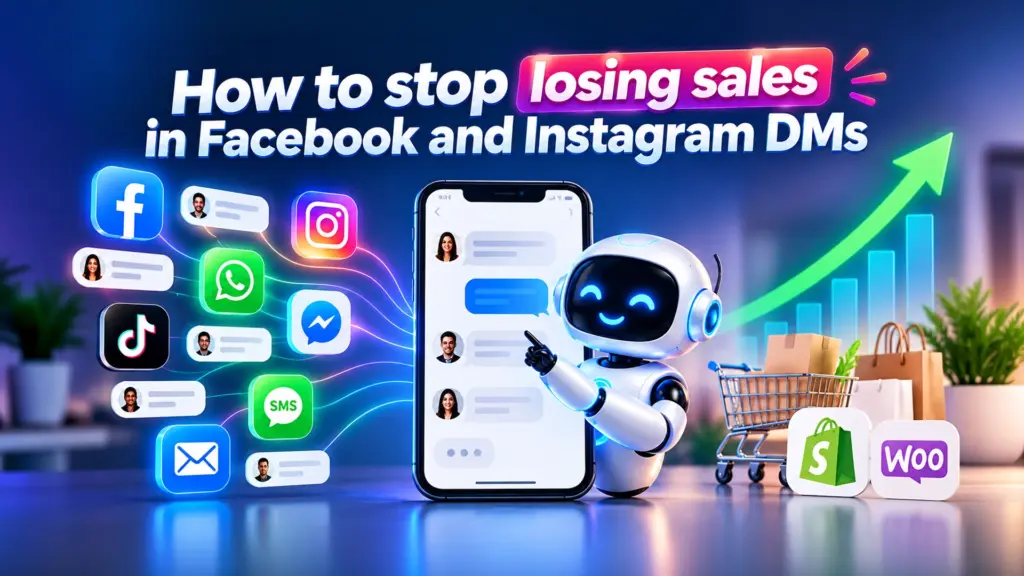
- One inbox for every channel. WhatsApp, Messenger, Instagram, TikTok, SMS, and email all landing in a single threaded view, with the customer’s full history attached — so anyone on the team can pick up a conversation and know exactly what’s already been said.
- An AI first responder, with a human safety net. Instant replies to the questions that repeat all day — price, sizing, delivery time, stock — with a clean handoff to a person the moment the conversation needs judgment, and a kill switch so a human can always take over.
- A pipeline behind the chat. Every conversation tagged by stage — new inquiry, negotiating, confirmed, shipped — so a “cold” DM from last week is something your team can find and follow up on instead of something that just disappears.
- Broadcasts for the ones who went quiet. A simple way to re-engage everyone who asked about a product and never ordered, instead of losing them the moment they stop replying.
- Attribution that connects the ad to the order. Knowing which campaign, page, or channel actually produced a completed sale — not just a click — so ad spend follows what’s working.
This is exactly the gap a tool like Leads Nimble is built to close: one inbox for WhatsApp, Messenger, Instagram, TikTok, SMS and email, an AI assistant that answers instantly and hands off when needed, built-in outbound calling for the leads worth a direct conversation, and ad attribution that shows which campaign actually paid off — connected to your Shopify or WooCommerce store rather than sitting apart from it.
A quick self-audit
Before you invest in a fix, it’s worth checking how bad the leak actually is:
- Can anyone on your team currently see every unanswered message across every channel from one screen?
- If a customer messaged three days ago and never replied to your answer, would anyone notice?
- Do you know which ad campaign produced your last ten completed orders — or just which one got the most clicks?
- If your best salesperson took a day off, would response times visibly slow down?
If any of those made you wince, the sale isn’t leaking because your product or your ads are wrong. You will keep losing sales in the gap between “customer asked a question” and “someone with the answer saw it in time” until that gap is closed by something other than luck.
This same dynamic isn’t unique to online retail, either — we’ve seen the identical pattern play out in how clinics lose new patients to slow WhatsApp and Messenger replies, even more directly in why car dealerships lose buyers to slow Facebook and Instagram DM replies, and in a slower-moving form in why course and coaching inquiries go cold without a fast reply. It’s one instance of a pattern we’ve traced across nine industries in why businesses lose leads in chat.
Want to see what a unified inbox looks like for your store specifically? Start a free trial — no card required, set up in minutes.



Discussion