Tag: whatsapp crm

  • Leads Nimble vs. Kommo vs. Zoko vs. Wati: How to Choose an Omnichannel Inbox

    Leads Nimble vs. Kommo vs. Zoko vs. Wati: How to Choose an Omnichannel Inbox

    Running a WhatsApp CRM comparison? There’s no shortage of WhatsApp and messaging tools competing for the same budget line right now, and most of them are genuinely good at what they focus on — the trick is matching the tool to what your business actually needs, not picking whichever has the flashiest homepage. Here’s an honest breakdown of where each of these fits, based on what they’re actually built for.
    WhatsApp CRM comparison: Leads Nimble vs Kommo vs Zoko vs Wati
    A WhatsApp CRM comparison of Kommo, Zoko, Wati and Leads Nimble by what each is actually built for.

    WhatsApp CRM comparison: quick summary

    Tool Built primarily for Channel coverage Pricing model
    Kommo (formerly amoCRM) Sales teams that think in pipelines WhatsApp + messengers, CRM-first Per-user, starting around $15/user/month
    Zoko Shopify sellers running WhatsApp commerce WhatsApp-first, e-commerce focused Plan-based, e-commerce feature set
    Wati Small teams wanting a simple shared WhatsApp inbox WhatsApp + Instagram Plan-based, budget-friendly entry tier
    Leads Nimble Businesses capturing leads across every ad-driven channel WhatsApp, Messenger, Instagram, TikTok, SMS, email Plan-based, includes built-in voice calling

    Pricing changes often across this category — always confirm current numbers directly with each provider before deciding. A 2024 review of WhatsApp Business Solution Providers by Gartner Peer Insights found buyers most frequently cited channel breadth and ease of setup — not price — as the deciding factor between similarly-priced platforms in this category.

    Kommo: best if your process is a sales pipeline first

    Kommo started as a CRM (amoCRM) and added messaging on top, which shows in what it does well: a genuinely capable visual sales pipeline, deal stages, and automation built around moving a lead through a structured process. It’s a strong fit for teams — real estate, B2B, service businesses — where the sales cycle has multiple stages and needs real pipeline discipline.

    The trade-off is that Kommo is a tool you configure and maintain. The pipeline logic, automations, and structure are powerful, but somebody on your team needs to build and keep them tidy. If your sales process is genuinely a multi-step pipeline, that investment usually pays off. If you mostly need fast replies to simple inquiries, it’s more infrastructure than you need.

    Zoko: best for Shopify-native WhatsApp commerce

    Zoko is built specifically for e-commerce sellers on Shopify running WhatsApp as a sales and support channel — product catalogs, abandoned cart recovery, and order-related messaging are core to what it does. For a Shopify store whose lead flow is almost entirely WhatsApp, it’s a focused, commerce-native option, similar in spirit to what we’ve described for e-commerce sellers losing sales in Facebook and Instagram DMs.

    The trade-off is channel breadth: it’s built around WhatsApp specifically, so a business getting significant volume from Instagram DMs or Facebook Messenger will find those channels either unsupported or bolted on rather than natively unified.

    Wati: best for a simple, low-cost shared inbox

    Wati is a straightforward, budget-friendly option for small teams that mainly need a shared WhatsApp inbox with basic automation and broadcast messaging, plus Instagram support. It’s easy to set up and reasonably priced at the entry tier, which makes it a common starting point for small businesses.

    The trade-off shows up as needs grow: AI capability and pipeline depth are limited compared to more full-featured platforms, so teams that outgrow “just answer messages faster” often find themselves needing to migrate to something with more structure.

    Where Leads Nimble fits

    Leads Nimble is built for a specific situation that doesn’t map neatly onto any of the three above: a business running ads across multiple platforms — Facebook, Instagram, TikTok — where leads arrive scattered across WhatsApp, Messenger, Instagram DMs, SMS, and email, and need to be captured, qualified, and converted regardless of which channel they came in on. This is the exact gap we describe in why businesses lose leads in chat across nine different industries.

    That means broader channel coverage than Zoko or Wati by default, a visual pipeline in the spirit of Kommo but paired natively with the messaging layer rather than bolted onto a CRM, and — distinctly — built-in outbound voice calling in the same platform, so a hot lead can get a phone call without switching tools. It’s also built with Bangla and English support and BDT pricing alongside USD, which matters if your business or customer base is in South Asia.

    WhatsApp CRM comparison: how to actually decide

    Four questions cut through most of the noise — the same four worth running through our WhatsApp CRM buyer’s checklist if you want the longer version:

    1. Is your lead flow WhatsApp-only, or spread across multiple ad platforms? WhatsApp-only points toward Zoko or Wati. Spread across Meta platforms and beyond points toward Kommo or Leads Nimble.
    2. Do you need a structured, multi-stage sales pipeline, or fast replies to simple questions? Structured pipeline points toward Kommo or Leads Nimble. Simple, fast replies is enough for Wati.
    3. Do you ever need to call a lead directly, not just message them? If yes, that narrows the field considerably — built-in voice calling isn’t standard across this category.
    4. Is your business or customer base based in South Asia, needing local language and currency support? That’s a genuine differentiator worth weighing alongside features.

    Frequently asked questions

    Is the most expensive option always the best choice?

    No. The right tool is the one that matches your actual lead volume, channel mix, and sales process — a simple business with low volume can be well served by a cheaper, more focused tool.

    Can I switch tools later without losing data?

    Usually yes for contacts and conversation history, though the ease varies by provider — ask about export options before committing to any platform, not after.

    Do any of these require a separate WhatsApp Business API account?

    Most platforms in this category, including Leads Nimble, handle WhatsApp Business API setup as part of onboarding — confirm this specifically if you don’t have in-house technical resources.

    Want to run your own WhatsApp CRM comparison against your channel mix? Start a free trial — no card required, set up in minutes.
  • WhatsApp CRM Buyer’s Checklist: What to Look for Before You Switch

    WhatsApp CRM Buyer’s Checklist: What to Look for Before You Switch

    Use this WhatsApp CRM Buyer’s Checklist before you commit to a switch. Most businesses don’t research a WhatsApp CRM carefully the first time — they grab whatever comes up first, get it working, and only discover the gaps six months later when the team has outgrown it. That pattern shows up in the data too: roughly 40% of companies switch CRM platforms within their first two years, and limited functionality is the single most common reason cited. This checklist is meant to shortcut that: the questions worth asking before you commit, not after.

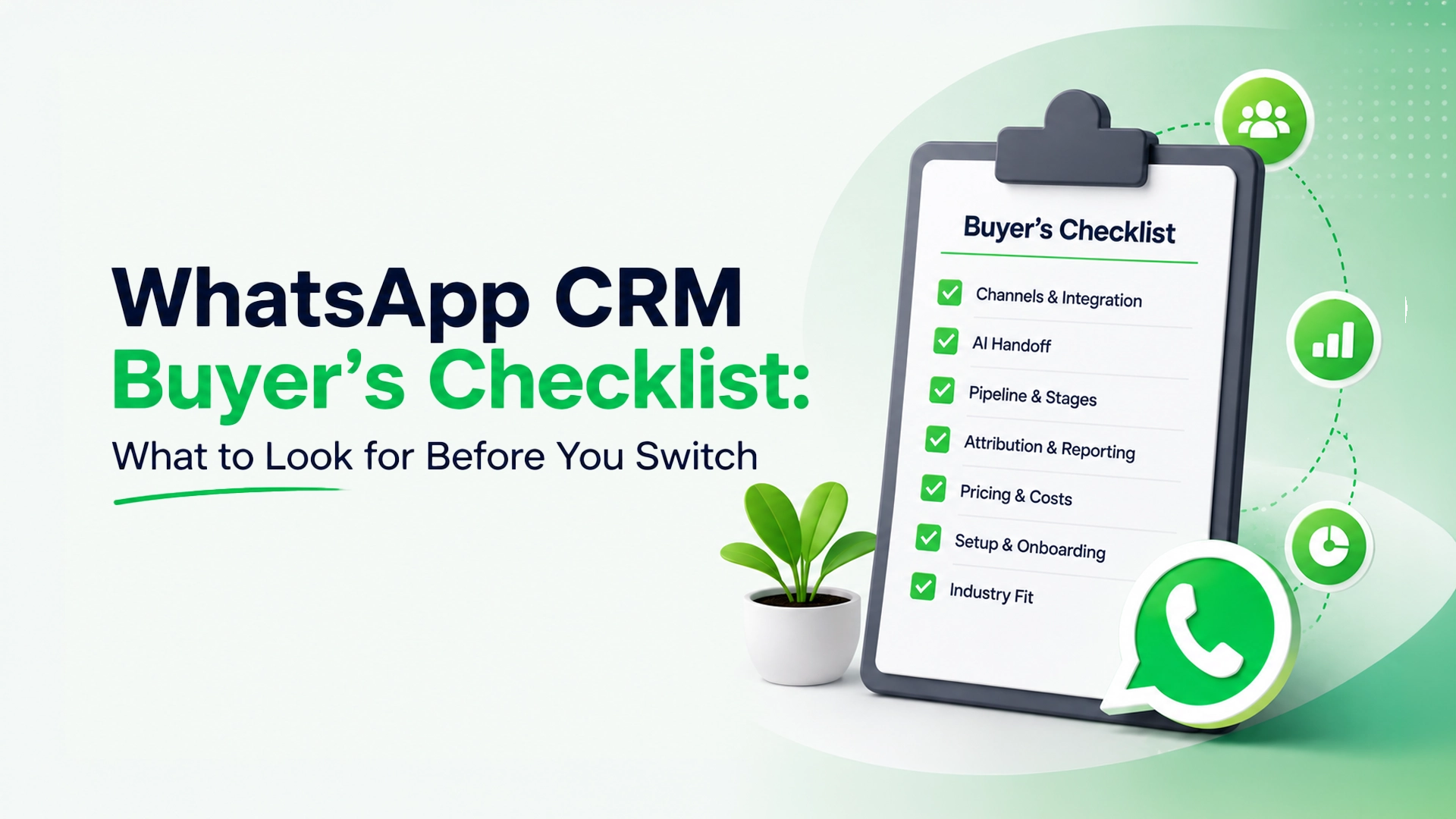
    WhatsApp CRM buyer's checklist before you switch tools
    This WhatsApp CRM buyer’s checklist covers seven questions worth asking before you switch.

    1. Which channels does it actually cover — not just advertise?

    WhatsApp is usually the anchor, but check whether Messenger, Instagram, TikTok, SMS, and email are genuinely integrated into the same inbox, or just listed on the pricing page as an add-on that needs separate setup. A tool that’s WhatsApp-only works fine until a lead messages you on Instagram instead — a scenario that happens constantly for businesses running ads on Meta’s platforms.

    2. Does the AI actually hand off to a human, or just loop?

    Almost every tool claims “AI automation” now. The real question is what happens when the AI hits a question it can’t answer. A good system hands off cleanly to a person with full conversation context and lets a human take over at any point. A weak one either loops the customer back to a menu or has no handoff at all, which is worse than no AI.

    3. Is there a real pipeline, or just tags?

    Tags tell you a lead’s status at a glance. A pipeline shows you where every lead sits in a process — new inquiry, qualified, negotiating, closed — and lets your team act on stalled deals instead of just labeling them. If your sales process has more than two steps, a tagging system alone won’t hold up.

    4. Can you see which ad or channel actually produced a sale?

    Plenty of tools track message volume. Fewer connect a completed sale or signed deal back to the specific ad, campaign, or channel that produced it. Without that, your ad budget optimizes for clicks and replies, not revenue.

    5. What’s the actual pricing model, and what’s excluded?

    WhatsApp CRM pricing is notoriously easy to misread. Look specifically for: per-user fees that scale awkwardly as your team grows, per-message or per-conversation charges layered on top of the base plan, and separate WhatsApp Business API costs that aren’t included in the headline price. A plan that looks cheap at 2 users can get expensive fast at 10.

    6. How long does setup actually take?

    Some platforms need a developer to configure webhooks and API connections before the first message can be sent. Others are usable within an afternoon. If you don’t have technical resources in-house, ask specifically about setup time before buying — not after.

    7. Does it fit your industry’s actual workflow?

    A tool built primarily for Shopify order confirmations will feel awkward for a real estate pipeline, and vice versa. Look for case studies or feature sets that match your specific use case — e-commerce, real estate, healthcare, or agencies managing several clients at once — rather than a generic “works for everyone” pitch.

    Common mistakes when choosing

    • Picking based on brand recognition alone. The best-known tool in the space isn’t automatically the best fit for your channel mix or budget.
    • Ignoring per-message costs during the trial. A free trial often waives usage-based fees that show up in the first real invoice.
    • Not testing the AI-to-human handoff before committing. This is the single feature most likely to frustrate customers if it’s done poorly, and it’s rarely obvious from a features page.
    • Choosing the cheapest plan and outgrowing it in months. It’s usually cheaper to pay slightly more up front for a system with room to grow than to migrate contact history and automations later.

    Frequently Asked Questions WhatsApp CRM Buyer’s Checklist

    Do I need a WhatsApp Business API account, or does the CRM handle that?

    It varies by provider — some include API setup in the price, others expect you to arrange it separately. Confirm this before signing up, since a missing API connection can stall onboarding by days.

    Is a cheaper, WhatsApp-only tool ever the right choice?

    Yes — if your leads genuinely only ever contact you on WhatsApp and you don’t run ads on Instagram or Facebook, a simpler, WhatsApp-first tool can be a reasonable, lower-cost fit.

    How important is the pipeline feature really?

    It depends on your sales cycle length. A same-day purchase decision (like most retail DMs) needs less pipeline structure than a multi-week decision (like real estate, B2B, or financial services), where tracking stage and follow-up matters far more.

    Leads Nimble covers all seven of these directly: WhatsApp, Messenger, Instagram, TikTok, SMS and email in one inbox, an AI assistant with a clean human handoff, a visual pipeline, ad attribution tied to actual conversions, transparent pricing, and same-day setup. See how it stacks up specifically against other platforms in our comparison of Leads Nimble, Kommo, Zoko, and Wati, or the full guide to why businesses lose leads in chat for industry-specific detail.

    Want to see it against your own checklist? Start a free trial — no card required, set up in minutes.
  • Qualifying Loan & Insurance Leads Without Losing Them to Slow Follow-Up

    Qualifying Loan & Insurance Leads Without Losing Them to Slow Follow-Up

    Response time decides more loan and insurance leads than price does. Someone fills out a form on your loan or insurance landing page. Ten seconds later, they’ve closed the tab and started filling out the same form on a competitor’s site — sometimes two or three more. In this industry, that’s not impatience. It’s how shopping for a loan or a policy normally works.

    Whoever calls back first usually gets the application. Not the lender with the best rate. Not the agency with the best reviews. The one who showed up while the prospect was still paying attention.

    Qualifying loan and insurance leads before slow follow-up loses them
    Insurance leads are almost always shopping several providers at once — speed is the lever.

    Why loan and insurance leads are uniquely time-sensitive

    Two things make this vertical harder than most. First, prospects are almost always comparison shopping by default — nobody requests one insurance quote or one loan estimate; they request several at once, on purpose. Second, in a lot of loan and insurance lead generation, the same lead is quite literally sold or shared to multiple agents or brokers at the same time, so several people are racing to be the first to call.

    Industry research on this is blunt: insurance companies reportedly lose as much as 84% of leads to quote abandonment, a rate significantly higher than the roughly 70% cart abandonment average typical of e-commerce, with most of that drop-off happening within the first day or two after a quote request. Response-time studies going back to MIT’s original Lead Response Management research (and repeated many times since, including by Harvard Business Review) consistently find that contacting a lead within minutes rather than hours dramatically changes the odds of ever reaching them at all, let alone converting them.

    For a loan officer or insurance agent, that means “I’ll call them back after lunch” is often the same as losing the lead entirely. Insurance leads do not wait, and neither do loan applicants — both have already asked someone else the same question.

    Where financial services teams actually lose insurance leads

    • Leads land in a personal WhatsApp or a shared inbox nobody’s watching in real time. A form submission from a Facebook or Google ad turns into a message that sits until someone happens to check.
    • There’s no shared view of where a prospect actually is. Has this person already been quoted? Are they waiting on a document? Did someone already promise them a callback today? Without a shared pipeline, two team members can easily contact the same lead with two different answers.
    • Record-keeping is scattered. In a regulated, trust-sensitive industry, being able to show exactly what was said, when, and by whom matters and that’s hard to reconstruct from a personal phone’s chat history after the fact.
    • Nurture stops the moment a lead goes quiet. Someone who wasn’t ready to switch providers today isn’t a dead lead — but without a system to follow up before a renewal date or a rate change, that opportunity just evaporates.
    • Nobody can trace which campaign is actually producing signed applications — as opposed to just form fills — so ad budget doesn’t necessarily go where it should.

    What actually fixes slow follow-up on insurance leads

    1. One inbox for every channel a lead might use — WhatsApp, Messenger, Instagram, SMS, and email — so a new inquiry is never sitting unseen in an app nobody’s monitoring.
    2. An AI assistant that acknowledges instantly, 24/7, handling the first round of routine questions (loan amount, coverage type, timeline) and handing off cleanly to a licensed agent the moment the conversation needs a real qualifying discussion — with a human always able to take over.
    3. Built-in voice calling, so the moment a lead looks serious, someone can call directly from the same platform instead of losing minutes switching tools.
    4. A visual pipeline shared across the team, so every prospect’s stage — quoted, documents pending, awaiting decision — is visible to everyone, not locked in one person’s head or inbox.
    5. A full, searchable conversation record, making it far easier to confirm what was communicated and when — useful in an industry where that kind of clarity matters.
    6. Broadcasts for nurture, so leads who weren’t ready this month hear from you again before a renewal date or rate change — instead of only when they happen to think of you.
    7. Attribution tied to actual signed business, not just form submissions, so marketing spend follows what converts.

    This is the specific gap Leads Nimble is built to close for loan officers, insurance agents, and financial services teams: one inbox across every channel a prospect uses, an AI assistant that responds instantly and hands off cleanly, built-in outbound calling, a shared pipeline, and ad attribution — all logged in one place instead of scattered across personal phones and separate tools.

    A quick self-audit on your insurance leads

    • If a quote request comes in at 7 p.m., how long before someone responds?
    • Can anyone on your team currently see, in one place, every lead’s stage and what’s already been discussed?
    • If a client disputes what they were told, how quickly could you pull up the actual conversation?
    • Do you know which ad or campaign produced your last five signed applications — or just which one had the most clicks?

    In a market where the same prospect is talking to several providers at once, the fastest, clearest responder usually wins the business. That is the whole argument for treating insurance leads as a speed problem rather than a pricing one. The fastest responder wins — not necessarily the best rate.

    The same pattern shows up in longer, higher-value B2B sales cycles too — see why B2B deals stall in WhatsApp follow-up, and in the comparison-shopping behavior we describe in why hotel and travel bookings go cold on WhatsApp. See the full pattern across nine industries in why businesses lose leads in chat.

    Want to see what this looks like for your team? Start a free trial — no card required, set up in minutes.
  • Why B2B Deals Stall in WhatsApp Follow-Up?

    Why B2B Deals Stall in WhatsApp Follow-Up?

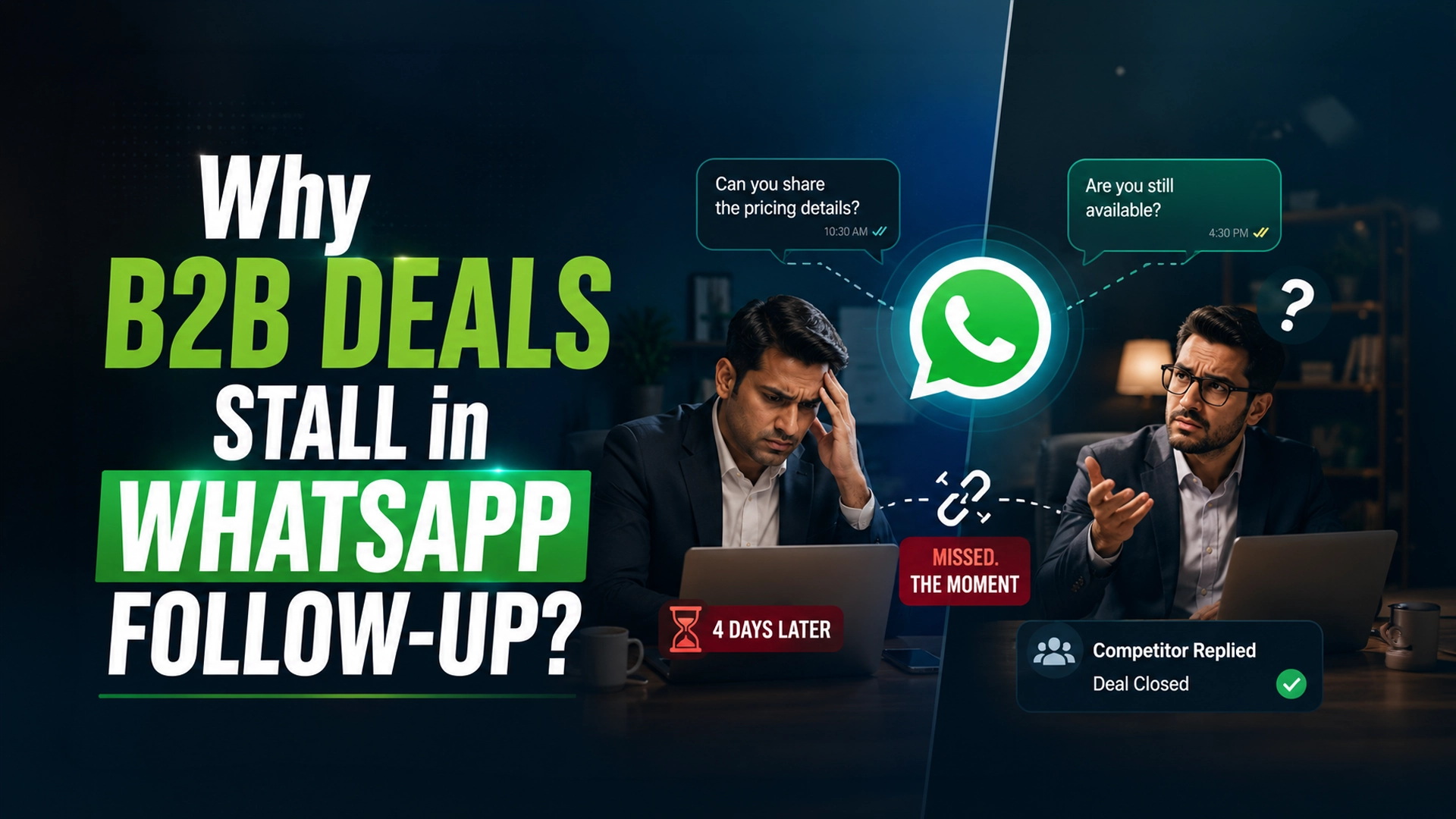
    In B2B, WhatsApp lead response time is the difference between a closed deal and a cold one. In most of the world, WhatsApp isn’t a side channel for B2B sales — it’s the main one. Across India, Southeast Asia, the Middle East, Latin America, and Africa, business buyers routinely expect to negotiate, clarify, and even close deals over WhatsApp rather than email. Which means when a B2B deal stalls, the cause is often mundane: a follow-up question sat unanswered for four days, buried among two hundred other chats on a rep’s personal phone.

    Here’s how it usually happens: a prospect messages a supplier after a demo with one clarifying question about pricing or delivery. The rep who handled the demo is in back-to-back meetings. Nobody else on the team even knows the conversation exists. Four days later, the prospect has moved forward with a competitor who happened to reply the same afternoon — not because that competitor had a better product, just a faster reply.

    Why B2B deals stall when WhatsApp lead response time slips
    WhatsApp lead response time, not price, is usually what decides a stalled B2B deal.

    Why WhatsApp is the real B2B channel in most markets

    This isn’t a workaround businesses fall back on — it’s often the primary, expected channel. Analysis of B2B outreach performance has found that warm WhatsApp follow-up in markets like India and Southeast Asia can achieve 30–50% reply rates, compared to roughly 3–5% for a well-run cold email campaign — a gap driven largely by the fact that WhatsApp messages get read almost immediately, while most emails are opened within the first few hours, if at all.

    What the data says about WhatsApp lead response time

    Speed to first contact isn’t a soft metric in B2B — it shows up directly in win rates. Sales research on this consistently finds that businesses that make the fastest initial contact with a prospect are up to 50% more likely to close the deal, in a market where the average B2B sale is worth significantly more than a typical consumer purchase — which makes every stalled conversation considerably more expensive to lose.

    This tracks with the broader pattern we’ve described in qualifying loan and insurance leads without losing them to slow follow-up: high-value, high-consideration purchases are exactly where a slow reply costs the most, because the prospect has other, comparable options and no strong reason to wait.

    Where B2B teams actually lose deals in WhatsApp

    • Conversations live on individual reps’ personal phones, so if that rep is busy, in a meeting, or out sick, nobody else even knows the conversation exists.
    • There’s no shared record across a long sales cycle. B2B deals often involve weeks of back-and-forth — pricing, specs, procurement questions — and losing that context when a second person picks up the thread means starting over.
    • Follow-up depends entirely on one person remembering. A prospect who went quiet mid-negotiation rarely gets a deliberate nudge; they simply fall off the radar.
    • Nobody can trace a closed deal back to its source — which trade show, campaign, or referral actually produced it — so it’s hard to know where to invest more.
    • Handoffs between marketing and sales lose messages. A lead captured by an ad or a landing page often lands in a general inbox nobody owns, rather than routing to the right rep immediately.

    How to fix WhatsApp lead response time on your team

    1. A shared inbox for every channel a prospect uses — WhatsApp, Messenger, Instagram, SMS, and email — so a deal is never trapped in one rep’s personal phone.
    2. An AI assistant that acknowledges instantly, 24/7, handling routine questions and confirming receipt while routing anything that needs judgment to the right rep — with a human always able to take over.
    3. A visual pipeline built for a longer sales cycle — inquiry, demo, proposal, negotiation, closed — so a stalled deal is a stage the whole team can see, not a conversation quietly going cold on someone’s phone.
    4. Broadcasts for nurturing stalled deals, so a prospect who went quiet after a proposal hears from you again before they’ve fully moved to a competitor.
    5. Attribution tied to closed revenue, not just messages sent, so marketing and sales can see which source is actually producing signed deals.

    This is the specific gap Leads Nimble is built to close for B2B teams: one inbox across WhatsApp, Messenger, Instagram, SMS and email, an AI assistant that responds instantly and routes cleanly to the right rep, a pipeline built for multi-touch sales cycles, and attribution that connects closed revenue back to its source — the same shared-workspace model we described for agencies managing leads for multiple clients, applied to a single sales team managing many accounts.

    Frequently asked questions

    Is WhatsApp actually a legitimate B2B sales channel?

    In most emerging markets, yes — it’s often the primary, expected channel for business communication, not an informal workaround. Reply rates on WhatsApp for warm B2B outreach are typically far higher than cold email.

    How much does WhatsApp lead response time actually affect B2B win rates?

    Considerably. Research on lead response time consistently finds the fastest responder has meaningfully better odds of closing the deal — regardless of price or product quality.

    Isn’t a slower, more considered reply better for high-value B2B deals?

    Thoughtfulness matters, but it isn’t the same as slowness. The goal is acknowledging quickly and routing the conversation to the right person fast — not necessarily sending a full proposal within minutes.

    What’s the most common reason B2B deals stall in chat?

    Rarely price or fit  usually a follow-up message that sat unanswered long enough for the prospect to lose momentum or move to a competitor who replied sooner.

    A quick self-audit

    • If your top salesperson is out sick, do their active WhatsApp conversations still get answered?
    • Can anyone on your team see, in one place, which deals have gone quiet and for how long?
    • Do you know which channel or campaign produced your last five closed deals?
    • How many “let me check internally and get back to you” conversations from last quarter ever got a follow-up?

    B2B deals rarely die from a bad answer. They die from no answer, sent too late to matter. Fix your WhatsApp lead response time and most of the rest takes care of itself. This is one of nine industries covered in why businesses lose leads in chat.

    Want to see what this looks like for your sales team? Start a free trial — no card required, set up in minutes.
  • Managing Leads for Multiple Clients Without 10 Different Logins

    Managing Leads for Multiple Clients Without 10 Different Logins

    Good agency lead management means never juggling ten different logins. Your agency runs paid ads for eight different clients. Each one has its own Facebook Page, its own Instagram account, and for at least three of them its own WhatsApp Business number. To check on any single client’s leads, someone on your team logs into a different set of accounts, with a different password, often on a different laptop because that’s whose credentials are saved where.

    By the time a lead has been sitting for two hours, it’s not because your team doesn’t care. It’s because “checking on Client B’s leads” requires logging out of Client A’s dashboard first.

    Agency lead management across multiple clients from one shared workspace
    Agency lead management breaks down at the login screen, not in the ad account.

    The real cost of agency lead management across many clients

    Most agencies don’t lose clients because the ads underperform. They lose clients because the proof of performance is hard to produce, and because leads slip through the cracks in the handoff between “the ad worked” and “someone replied to the person who clicked it.” This isn’t a niche problem — a 2024 HubSpot study found that roughly 40% of marketers cite proving ROI to clients as their single biggest challenge, a number that has stayed essentially flat for years.

    A few patterns show up almost universally:

    • Every client lives in its own silo. Different logins, different inboxes, different phone numbers — which means your account managers spend real time just switching contexts, not doing account management.
    • One team member becomes the bottleneck. Whoever happens to “own” a client’s channels is the only person who can respond quickly, so a single sick day or a busy afternoon means that client’s leads go cold.
    • Reporting is manual and after-the-fact. Proving to a client that their ad spend produced actual leads (and actual sales) usually means someone stitching together screenshots from three different platforms right before a monthly check-in call — instead of having the answer on demand.
    • Nothing is centrally visible to agency leadership. If a client is unhappy about response times, there’s often no easy way to check whether that’s actually true across all their channels, or just one loud complaint.
    • Onboarding a new client means rebuilding the wheel. New channels to connect, new logins to create, new templates to write from scratch — every single time.

    What actually fixes agency lead management

    The fix isn’t hiring a dedicated person per client. It’s putting every client’s lead flow into one workspace your whole team can access — with the right boundaries so client data stays properly separated:

    1. One shared, permissioned workspace for every client’s leads across WhatsApp, Messenger, Instagram, TikTok, SMS and email — so any authorized team member can pick up any client’s conversation without needing five separate sets of credentials.
    2. An AI assistant per client that answers common questions instantly and hands off to the right account manager — so a lead never sits unanswered just because the one person who “owns” that client is unavailable.
    3. Reusable templates and broadcast tools, so onboarding client number nine doesn’t mean starting from a blank page every time.
    4. Built-in reporting and ad attribution per client, so “here’s what your ad spend actually produced this month” is a real-time answer instead of a slide deck assembled the night before the call.
    5. Visibility for agency leadership across every account, so response-time or follow-up problems get caught before a client has to complain about them.

    This is the specific problem Leads Nimble is built to solve for agencies: every client’s leads across every channel routed into one shared, permissioned workspace, with an AI assistant, built-in voice calling, broadcast campaigns, and ad attribution running underneath — so your team manages leads for eight clients with the same ease as one, and can prove the results without a scramble at the end of the month.

    A quick agency lead management self-audit

    • How many separate logins does your team juggle to check on all your clients’ leads right now?
    • If your point person for a client took the day off, would that client’s leads still get answered on time?
    • Could you produce a real ad-attribution report for any client in the next five minutes — or would it take an afternoon?
    • How long does it typically take to fully onboard a new client’s channels into your workflow?

    Clients rarely churn because the strategy was wrong. They churn because they can’t see the proof, and because their leads didn’t get answered fast enough to matter. Both of those are agency lead management problems rather than strategy problems — and both are fixable without adding headcount.

    The same shared-workspace fix applies just as well on the other side of the table — see why B2B deals stall in WhatsApp follow-up for how the identical problem plays out inside a single sales team managing many accounts, and if you’re evaluating tools for this, our WhatsApp CRM buyer’s checklist covers exactly what to look for in multi-client permissioning. This agency problem is also one piece of the wider pattern in why businesses lose leads in chat.

    Curious what running your whole client roster from one workspace looks like? Start a free trial — no card required, set up in minutes.
  • The Real Cost of a Slow Reply: Turning Course Inquiries into Enrollments

    The Real Cost of a Slow Reply: Turning Course Inquiries into Enrollments

    This is the real cost of a slow reply on a course enrollment inquiry. Someone sees your ad for an online course. They’re interested enough to stop scrolling, tap through, and send a message: “How much is it, and is there a payment plan?”

    That message is the entire sale. Not a form fill. Not a lead magnet download. An actual person, actively deciding, asking the one question standing between them and enrolling.

    If nobody answers for six hours, most of that motivation is gone by the time you reply. Not because the course got worse. Because the moment of “I’m doing this” doesn’t wait around for a business to get back to its inbox.

    The real cost of a slow reply to a course enrollment inquiry
    Course enrollment is decided in the DM, while the motivation spike is still live.

    Course enrollment is won or lost in the DM, not the sales page

    For education and coaching businesses running ads on Facebook and Instagram, the sales page does the persuading, but the DM does the closing. Prospective students rarely enroll cold off a landing page — they message first, almost always with a small number of predictable questions: price, payment plans, start dates, whether it’s live or self-paced, whether it’ll actually work for their specific situation.

    That means the entire outcome of an ad campaign often comes down to one thing that has nothing to do with the course itself: how fast, and how well, someone answers that first message. It’s the same dynamic we’ve described in how e-commerce sellers lose sales in Facebook and Instagram DMs  a course inquiry is simply a higher-consideration version of the same conversation.

    Interest has a shelf life

    This isn’t just intuition — it shows up consistently in lead-response research across industries, including education specifically. Research cited by Harvard Business Review found that inquiries contacted within five minutes are roughly 21 times more likely to convert than those contacted thirty minutes later — and for course and coaching businesses specifically, that window tends to be even shorter than it is for degree programs, since the decision is more impulsive and the alternatives are one ad away.

    For a course or coaching offer, there’s an added twist: the purchase decision is emotional and momentum-driven. Someone messaging about a course is often mid-motivation-spike — they just watched a testimonial, just imagined the outcome, just decided “this could actually change something for me.” That feeling fades. By the time a reply arrives a day later, the version of them that was ready to enroll has often moved on to something else entirely — sometimes literally a competitor’s course ad that appeared in the meantime.

    Where coaching businesses actually lose course enrollments

    Losing a course enrollment here usually isn’t a sales-skill problem. It’s an operational one, and it shows up the same way across most small and mid-sized education businesses:

    • One person is managing DMs across four platforms. Instagram, Facebook, WhatsApp, and email inquiries all landing in different places, answered whenever there’s a spare five minutes between everything else running the business.
    • Repeated questions eat the whole day. The same handful of questions — price, payment plans, cohort dates, refund policy — get typed out fresh every single time, which means the actual selling (the parts that need a human) gets less attention, not more.
    • Interested-but-not-yet-enrolled leads just disappear. Someone asks about pricing, says “let me think about it,” and there’s no system to follow up before the next cohort closes. They wanted to say yes; nobody reminded them in time.
    • There’s no visibility into what’s actually converting. Which ad, which landing page, which specific message brought in this month’s enrollments? Without that, budget keeps going to whatever has the best click rate, not the best enrollment rate.

    What actually moves course enrollment numbers

    The fix isn’t “reply faster, manually.” It’s removing the bottleneck between “someone asks a question” and “someone gets an accurate answer”:

    1. One inbox for every channel a prospective student uses — Instagram, Facebook Messenger, WhatsApp, SMS, and email — so nothing sits in an app nobody’s checking.
    2. An AI assistant that answers the repeat questions instantly, 24/7 — price, payment plans, start dates — with a clean handoff to a real person the moment someone needs a genuine conversation about whether the course fits them.
    3. A visible pipeline for every inquiry, from first message to enrolled, so “interested but hasn’t paid yet” is a stage your team can see and act on instead of a conversation that quietly goes cold.
    4. Broadcasts to nurture the ones who said “let me think about it” — a reminder before the cohort closes, a testimonial, an answer to the objection they didn’t quite say out loud.
    5. Attribution that connects an ad to an actual enrollment, not just a click or a comment, so ad spend follows what genuinely fills seats.

    This is precisely the operational gap Leads Nimble is built to close: a single inbox across Instagram, Messenger, WhatsApp, SMS and email, an AI assistant that responds instantly and hands off cleanly when a real conversation is needed, a pipeline to track every inquiry through to enrollment, broadcast tools to bring back the ones who went quiet, and ad attribution that shows which campaign is actually producing paying students.

    A quick self-audit

    • If someone messages your course ad at 11 p.m., how long before they get a real answer?
    • How many “let me think about it” conversations from last month ever got a follow-up?
    • Do you know which specific ad or post produced your last five enrollments — or just which one got the most engagement?
    • If you took a week off, would inquiries pile up unanswered?

    The course doesn’t need to be better to win more course enrollment decisions. The reply just needs to show up while the person asking is still the version of themselves that wanted to say yes.

    This same “motivation fades fast” dynamic shows up in why real estate leads go cold in WhatsApp and Messenger too — high-consideration purchases are exactly where a slow reply costs the most. It’s one of nine industries we cover in why businesses lose leads in chat.

    Want to see this working for your own course or coaching business? Start a free trial — no card required, set up in minutes.
  • Why Car Buyers Go Cold in Facebook and Instagram DMs?

    Why Car Buyers Go Cold in Facebook and Instagram DMs?

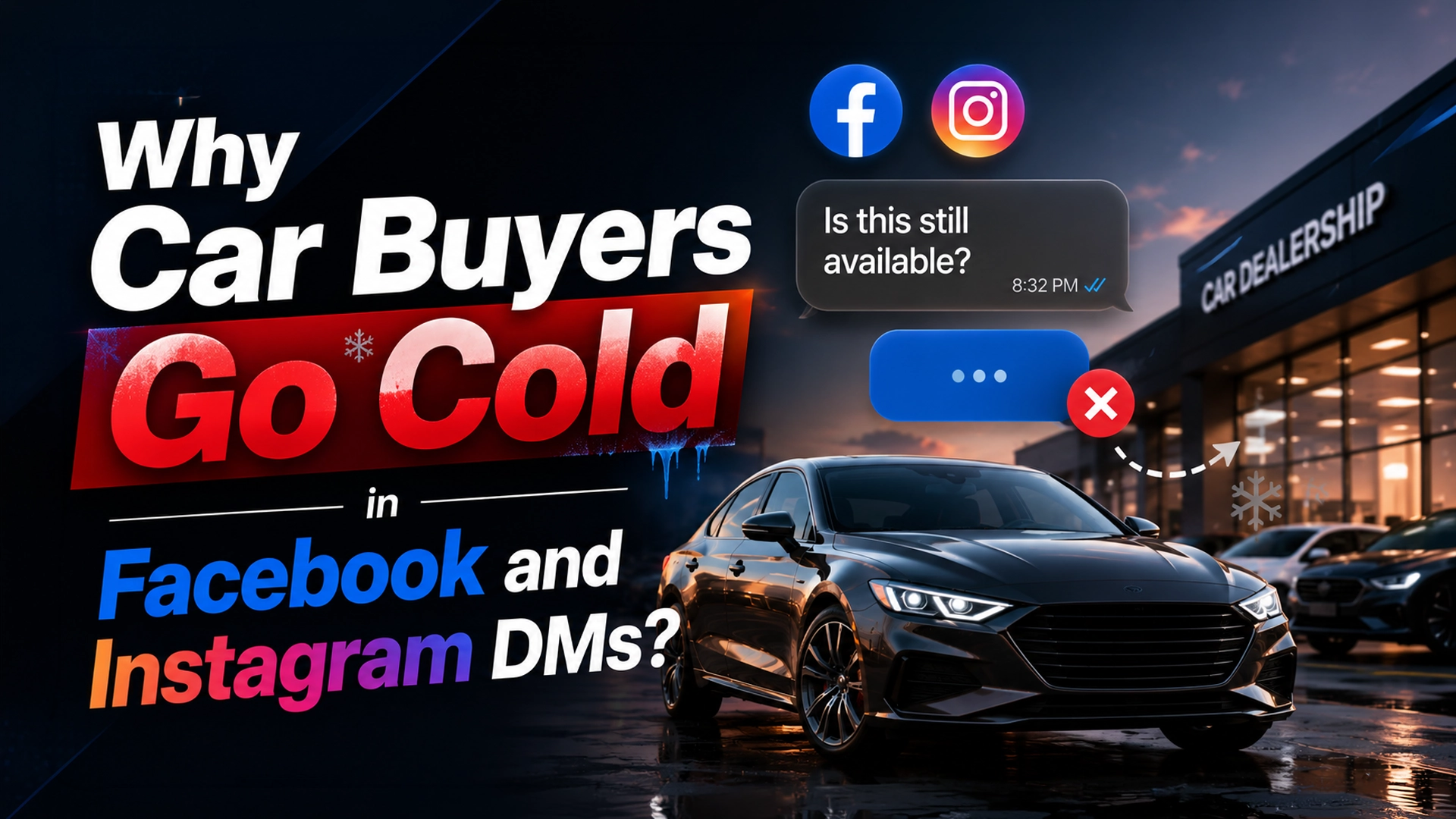
    “Is this still available?” is the single most common message that costs car dealership leads. It’s the single most common message a car dealership gets on Facebook Marketplace and Instagram and how fast it gets answered often decides whether that buyer shows up on your lot or someone else’s. Car buyers move fast: a large share of qualified leads purchase a vehicle within just a few days of their first inquiry, which means a slow reply doesn’t just delay a sale, it usually loses it outright.

    Here’s the version of this that plays out constantly: a buyer sees a used-car listing boosted on Instagram, DMs “is this still available?”, and the message sits for a few hours while staff are busy on the lot. By the time someone replies, the buyer has already messaged and bought from a dealership that answered in minutes.

    Why car dealership leads go cold in Facebook and Instagram DMs
    Car dealership leads expire inside Messenger’s 24-hour window, not on the lot.

    “Time kills deals” is truer for car dealership leads in chat

    Car sales veterans have said “time kills deals” for decades about walk-in traffic and phone leads. The same logic applies, only faster, to Facebook and Instagram DMs. A buyer messaging about a specific vehicle has already done their research and picked a car — they’re not browsing, they’re close to buying. The dealership that responds first, with the right information, usually gets the sale, almost regardless of price.

    What the data says about dealership response times

    The numbers here are stark. Industry research compiling dealership phone and lead data found that only about 13% of dealerships respond to leads within five minutes, while more than three-quarters take over an hour — and roughly a third of inbound callers never reach a qualified person at all.

    Facebook Marketplace adds a hard deadline most dealerships don’t realize exists: Messenger closes the ability to message a buyer back if a dealership doesn’t respond within 24 hours of their inquiry — and by then, research shows, they’ve already bought elsewhere. The same source notes that roughly 40% of Marketplace leads arrive after hours, nights, weekends, and holidays — exactly when dealership staff are least likely to be watching the inbox.

    This mirrors the same “whoever replies first wins” pattern we described in why real estate leads go cold in WhatsApp and Messenger, and the DM-as-storefront dynamic from how e-commerce sellers lose sales in Facebook and Instagram DMs — auto dealerships are simply the highest-stakes version of both.

    Where car dealership leads actually get lost

    • Leads are scattered across Marketplace, Instagram, the website form, and phone, with no single view of what’s been asked and answered where.
    • One person checks Facebook once a day, which means anything that arrived after that check sits until the next one.
    • Evening and weekend inquiries pile up unanswered — exactly the windows when serious buyers are browsing listings after work.
    • There’s no shared record of the conversation, so if a different team member picks up the thread, they don’t know what’s already been discussed about the vehicle, financing, or trade-in.
    • Nobody tracks which listing or ad actually produced a sale, so ad spend and listing effort don’t necessarily go where they’re working.
    • Once the 24-hour Messenger window closes, the lead is gone for good — there’s no way to proactively message them again.

    What actually fixes slow replies to car dealership leads

    1. One inbox for every channel a buyer might use — Facebook Marketplace, Instagram, Messenger, WhatsApp, SMS, and email — so nothing sits unseen while staff are on the lot.
    2. An AI assistant that replies instantly, 24/7, confirming availability and answering the routine questions (“is it still available,” “what’s the mileage,” “can I see it today”) within the Messenger response window, and handing off to a salesperson the moment it’s a real conversation.
    3. Built-in voice calling, so a serious buyer can get a call back immediately instead of the conversation staying stuck in text.
    4. A visual pipeline for every inquiry, from first message to test drive to sale, so nothing depends on one person’s memory.
    5. Broadcasts for buyers who looked and didn’t buy — a new listing, a price drop — sent before they’ve fully moved on to another dealership.
    6. Attribution tied to actual sales, not just messages, so you know which listings and ad spend are genuinely producing buyers.

    This is the specific gap Leads Nimble is built to close for dealerships: one inbox across Marketplace, Instagram, Messenger, WhatsApp, SMS and email, an AI assistant that responds instantly inside the Messenger window and hands off cleanly, built-in outbound calling, a shared pipeline, and attribution tying ad spend to actual sales.

    Frequently asked questions

    How fast should a dealership respond to a Facebook Marketplace message?

    As close to instantly as possible, and always within Messenger’s 24-hour window — after that, the platform blocks you from messaging the buyer again, and by then most buyers have already purchased elsewhere.

    Why do so many dealerships respond slowly despite knowing speed matters?

    Usually not from lack of effort — car dealership leads are a staffing and tooling problem. They arrive across multiple platforms and after hours, and without a system to catch them all, they simply wait for whoever next checks the right inbox.

    Can an AI assistant handle “is this still available” messages safely?

    Yes — that’s exactly the kind of routine, factual question AI handles well, with a clean handoff to a salesperson the moment the buyer wants to negotiate, schedule a test drive, or discuss financing.

    Does response time matter more for used cars or new cars?

    Both, but the effect is often sharper for used-car listings on Marketplace and Instagram, since buyers are frequently comparing several specific, similar vehicles across different dealerships at once.

    A quick self-audit

    • If a buyer messages a listing at 8 p.m. on a Saturday, what happens?
    • Do you know how many Marketplace or Instagram messages went unanswered past Messenger’s 24-hour window last month?
    • Can you trace last month’s sales back to the specific listing or ad that generated the lead?
    • If your one Facebook-checking employee took a week off, would leads pile up unanswered?

    Buyers aren’t choosing the dealership with the better price or the nicer showroom. They’re choosing whichever one replied while they were still looking. Treat car dealership leads as a stopwatch problem and most of the rest sorts itself out. This is one of nine industries covered in why businesses lose leads in chat.

    Curious what this looks like for your dealership? Start a free trial — no card required, set up in minutes.
  • Why Real Estate Leads Go Cold in WhatsApp and Messenger

    Why Real Estate Leads Go Cold in WhatsApp and Messenger

    Real estate leads in WhatsApp and Messenger go cold faster than almost any other channel. A buyer sees a listing ad on Instagram at 9 p.m. on a Tuesday. They tap through, like what they see, and send a message: “Is this still available? Can I see it this weekend?”

    The agent who posted the ad is mid-showing with another client. By the time they check their phone two hours later, the buyer has already messaged four other listings that looked similar. Three of those agents replied within minutes. That buyer is probably touring one of their properties this weekend — not yours.

    This isn’t a story about a bad agent. It’s the default outcome of how real estate leads move today, unless something is actively built to prevent it.

    Why real estate leads go cold in WhatsApp and Messenger
    Real estate leads now arrive in chat, and they expect a reply on chat’s timescale.

    The real estate leads lifecycle has moved into chat

    Buyers used to call. Now they message. A property inquiry that starts on a Facebook or Instagram ad almost always continues in WhatsApp or Messenger — a channel that feels casual, immediate, and personal, which also means buyers expect a reply on a completely different timescale than an email.

    That shift matters more than it looks. An email sitting unanswered for two hours is normal. A WhatsApp message sitting unanswered for two hours feels like being ignored — and in a market where the same listing (or one nearly identical) is being advertised by three other agents, a buyer with options doesn’t wait around to find out if you were just busy.

    How fast is “fast enough”?

    Response-time research is unusually consistent on this point. Studies tracing back to MIT’s original Lead Response Management research — and repeatedly reinforced since, including by Harvard Business Review — have found that contacting a lead within five minutes can make you dramatically more likely to qualify them than waiting even thirty minutes, with some analyses putting the gap as high as 21 times.

    This lines up with what the industry’s own buyer research shows: the National Association of Realtors’ 2025 Home Buyers and Sellers Generational Trends report found that 95% of buyers rate an agent’s responsiveness as “very important,” and three-quarters of buyers only ever interviewed a single agent before choosing one — a strong signal that whoever responds first usually doesn’t get compared against anyone else at all.

    For an individual agent juggling showings, calls, and paperwork, “respond within five minutes” isn’t a discipline problem. It’s a physically impossible standard to hit consistently without help.

    Where real estate teams actually lose leads

    Teams rarely lose real estate leads through lack of effort. The failure points are structural:

    • Leads land in one agent’s personal phone. Whoever posted the ad gets the WhatsApp message, and if they’re unavailable, nobody else on the team even knows the lead exists.
    • Evenings and weekends go unanswered. Property inquiries spike exactly when agents are out doing showings — the worst possible time for a message to sit unread.
    • There’s no shared record of the conversation. If a lead messages a second time, or a different agent picks up the thread, there’s no history of what was already discussed — timeline, budget, preferred areas, whether they’ve already seen three other properties.
    • Nobody tracks which ad or listing actually produced a closed deal. Marketing spend keeps flowing to whichever campaign has the best click-through rate, not the one that actually turns into signed buyers.
    • Cold leads just disappear. A buyer who asked about a property two months ago and went quiet isn’t “not interested” — they’re often just not ready yet. Without a system to keep them warm, that lead is gone the moment the conversation stops.

    What actually closes the gap on real estate leads

    The fix isn’t asking agents to check WhatsApp more often. It’s building a system where the first response doesn’t depend on one person’s availability:

    1. A shared inbox for every channel a lead might use — WhatsApp, Messenger, Instagram, SMS, and email — so a lead is never trapped in one agent’s personal phone.
    2. An AI agent that answers instantly, 24/7, handling the first round of questions (availability, price range, scheduling a viewing) and handing off to a human the moment it’s a real qualifying conversation — with a human always able to step in.
    3. Built-in voice calling for the leads worth a real conversation. The moment a lead looks serious, a team member can call directly from the same platform instead of switching tools and losing momentum.
    4. A visual pipeline that tracks every buyer from inquiry to close — so “this lead went cold” is a stage you can see and act on, not a conversation that quietly vanished.
    5. Broadcasts to re-engage buyers who aren’t ready yet. New listing, price drop, open house — sent to everyone who showed interest before, instead of losing them after one unanswered follow-up.
    6. Attribution tied to actual closings, not just clicks, so ad spend goes toward the campaigns that produce buyers, not just inquiries.

    This is the specific gap Leads Nimble is built around: one inbox that catches WhatsApp, Messenger, Instagram, SMS and email leads regardless of which agent posted the ad, an AI assistant that responds instantly and hands off cleanly, outbound voice calling built into the same platform, and a pipeline plus ad attribution so your team can see — and prove — where deals actually come from.

    A quick gut-check for your team

    • If a lead messages at 9 p.m. on a Saturday, what happens? Be honest.
    • If your top-performing agent got sick for a week, would your lead response time visibly get worse?
    • Can you currently trace last month’s three closed deals back to the specific ad or listing that generated them?
    • Do you know how many leads from last month never got a second follow-up after the first message?

    Buyers aren’t choosing the best agent. They’re choosing the first one who showed up, which is why real estate leads reward speed over polish. The agencies winning right now aren’t necessarily better at real estate — they’ve just made sure “first” doesn’t depend on luck.

    This “whoever replies first wins” pattern isn’t unique to real estate, either — we’ve seen it play out just as clearly in how clinics lose new patients to slow message replies, why hotel and travel bookings go cold on WhatsApp, why car dealerships lose buyers in Facebook and Instagram DMs, and in the slower-moving version described in why course inquiries go cold without a fast reply. See the full pattern across all nine industries in why businesses lose leads in chat.

    Curious what this looks like for your team specifically? Start a free trial — no card required, and it’s set up in minutes, not weeks.

  • Why Hotel and Travel Inquiries Go Cold on WhatsApp?

    Why Hotel and Travel Inquiries Go Cold on WhatsApp?

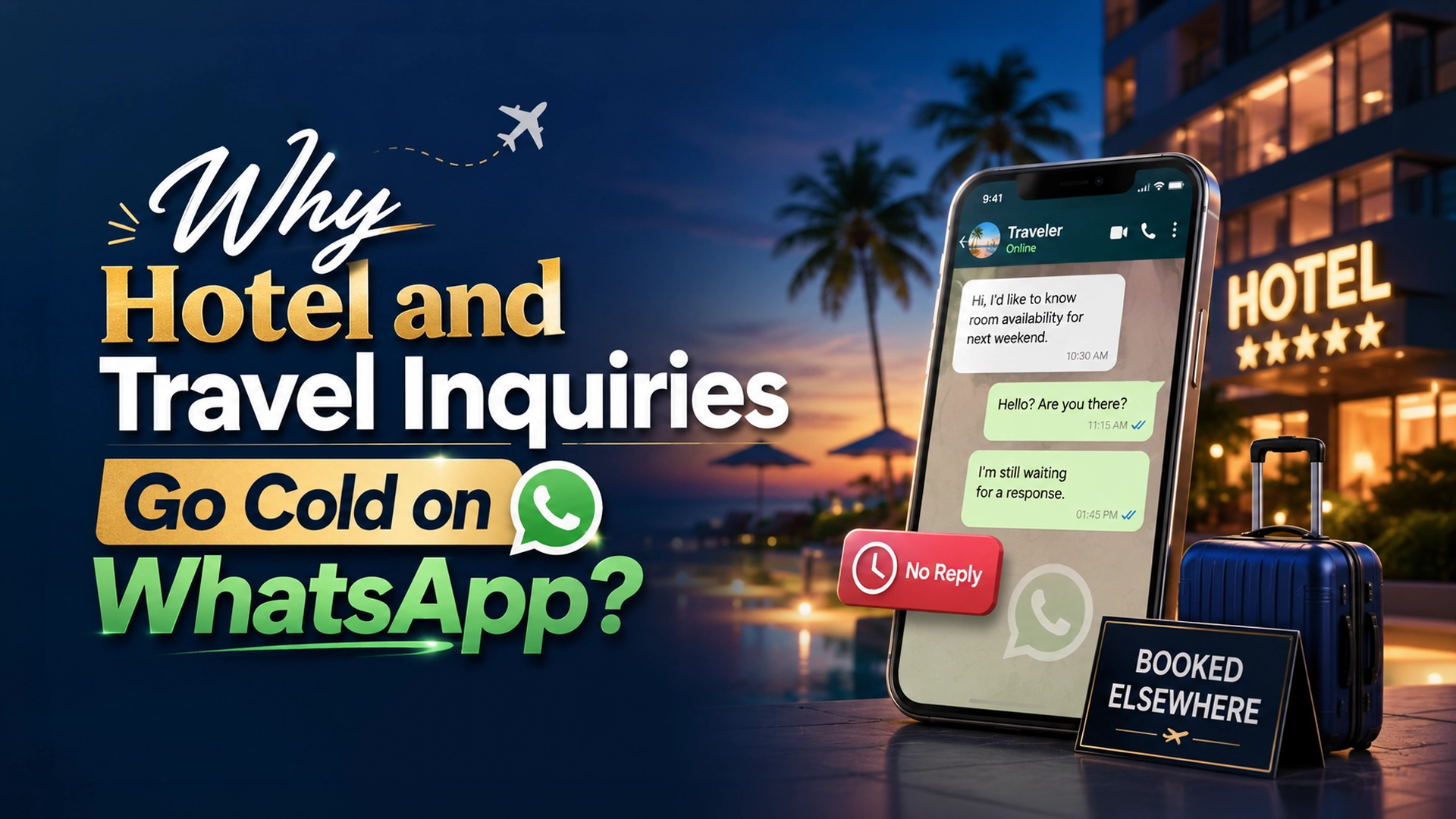
    Slow hotel WhatsApp inquiries are the easiest booking to lose. Travelers and hotel guests now expect a WhatsApp reply in minutes, not hours. When a travel agency or hotel takes too long to answer a booking inquiry, the guest doesn’t wait patiently — they book somewhere else, often through an OTA that charges the property a 15–25% commission for the exact booking it could have kept direct. Slow replies aren’t just lost leads in travel; they’re lost margin.

    Here’s how it plays out: someone sees an Instagram ad for a boutique hotel or a tour package, messages to ask about rates and availability, and hears nothing back for a few hours. By the time someone replies, that traveler has already messaged two more properties — or simply booked through Booking.com, which never left them waiting.

    Why hotel and travel inquiries go cold on WhatsApp
    Hotel and travel inquiries are impulse-driven — the window to reply is short.

    Why hotel and travel inquiries are especially unforgiving on response time

    A few things make this vertical harder than most. First, the inquiry is often impulse-driven — someone sees an ad mid-daydream about a trip and messages while the excitement is fresh, a window that closes fast. Second, travelers routinely message several properties or agencies at once, the same way they compare flights or hotel rates across multiple tabs — not unlike how loan and insurance shoppers request several quotes at once. Third, inquiries often arrive across time zones, at hours when on-site staff simply aren’t working.

    What the platforms themselves already assume about response time

    This isn’t just a best practice — some booking platforms enforce it directly. Vacation rental research on this is specific: Airbnb requires hosts to respond to new guest inquiries within 24 hours, and Vrbo requires a response within one hour for critical stay-related questions during a guest’s stay — with slow responders penalized in search ranking on both platforms. If OTAs are already treating response time as a ranking factor, it’s a reasonable bar for your own direct channels too.

    The same pattern we described in why real estate leads go cold in WhatsApp and Messenger holds here: the business that replies first usually wins the booking, regardless of price or amenities, simply because the guest stopped shopping around the moment they got a real answer.

    Where hotels, tour operators, and travel agencies actually lose bookings

    • Guest messages are split across OTA inboxes, email, SMS, and WhatsApp, with no single view of who’s asked what, so replies get missed simply because nobody was watching the right inbox.
    • Front-desk or on-site staff are busy with guests physically present, which is exactly when a message from a prospective guest arrives and sits.
    • International inquiries land outside business hours, and by the time staff are back online, the traveler has already booked elsewhere.
    • There’s no record of who already quoted a rate or answered a question, so a guest can get two different answers about pricing or availability from two staff members.
    • Undecided inquiries just disappear. Someone who asked about a package and went quiet isn’t necessarily uninterested — without a follow-up system, that inquiry is gone.
    • Nobody can trace which ad or channel actually produced a direct booking versus one that went through an OTA, so it’s hard to know where marketing spend is really paying off.

    What actually fixes cold hotel and travel inquiries

    1. One inbox for every channel a guest might use — WhatsApp, Messenger, Instagram, SMS, and email — so nothing sits unseen in an app nobody’s monitoring.
    2. An AI assistant that replies instantly, 24/7, handling routine questions (rates, availability, what’s included, check-in times) across time zones, and handing off to staff the moment a conversation needs a human touch.
    3. A shared pipeline for every inquiry, from first message to confirmed booking, so nothing depends on one staff member remembering a conversation.
    4. Broadcasts for undecided travelers — a gentle nudge with availability or a limited-time rate, instead of losing the inquiry the moment it goes quiet.
    5. Attribution tied to actual direct bookings, not just inquiries, so you can see which ad or channel is genuinely reducing your OTA commission spend.

    This is the specific gap Leads Nimble is built to close for travel and hospitality businesses: one inbox across WhatsApp, Messenger, Instagram, SMS and email, an AI assistant that responds instantly around the clock and hands off cleanly to staff, a shared booking pipeline, and attribution that shows which channel is actually driving direct bookings instead of OTA-fee bookings.

    Frequently asked questions

    How fast should a hotel or travel agency respond to a WhatsApp inquiry?

    As close to instantly as possible. Travelers routinely message multiple properties or agencies at once, and the first clear, accurate reply usually wins the booking — regardless of price.

    Does slow response time actually cost direct bookings?

    Yes. Major OTAs already treat response time as a ranking signal for hosts, and travelers who don’t get a timely reply from a direct channel simply complete the booking through the OTA instead — the exact outcome a faster reply could have avoided.

    Can an AI assistant handle guest questions across time zones?

    It can handle the routine ones well — rates, availability, amenities, check-in details — 24/7, regardless of when the inquiry arrives, with a clean handoff to staff for anything that needs a human judgment call.

    What’s the most common way travel businesses lose an inquiry?

    It typically isn’t a bad reply — it’s no reply at all, because the message landed in a channel nobody was actively watching at that moment.

    A quick self-audit

    • If a guest messages your Instagram Page at 2 a.m. their time, what happens?
    • Can your team see every unanswered inquiry across every channel from one screen?
    • Do you know which channel or ad produced your last ten direct bookings — or just which OTA sent the most traffic?
    • How many “still deciding” inquiries from last month ever got a follow-up?

    The properties and agencies winning direct bookings right now aren’t necessarily cheaper or nicer — they’re simply the ones who answered hotel and travel inquiries while the traveler was still in the mood to book. This is one of nine industries covered in why businesses lose leads in chat.

    Want to see what this looks like for your property or agency? Start a free trial — no card required, set up in minutes.
  • How to Stop Losing Sales in Facebook & Instagram DMs: A Guide for E-commerce Sellers

    How to Stop Losing Sales in Facebook & Instagram DMs: A Guide for E-commerce Sellers

    Stop Losing Sales in Facebook & Instagram DMs: Facebook Instagram DM sales are won or lost in exactly this moment. Somewhere right now, a customer is typing “is this available in blue?” into your Instagram DMs. They’re ready to buy. They have their card out, or they’re already planning which courier to ask for. And unless someone replies in the next few minutes, they’re going to close the app and message the next shop that shows up in their feed.

    This is the part of e-commerce that doesn’t show up in most “abandoned cart” reports — because the customer never got as far as a cart. The sale died in a chat window nobody was watching.

    Most sellers lose sales in DMs before the customer ever reaches a cart.

    Stop Losing Sales in Facebook & Instagram DMs

    DM commerce isn’t a side channel anymore – it’s the storefront

    For a huge share of online sellers, especially those running ads on Facebook and Instagram, the DM inbox is the checkout counter. A customer sees an ad, taps through, and instead of browsing a catalog, they just ask a question: price, size, delivery time, whether it’s in stock. The entire sales conversation — question, negotiation, address, payment method — happens in chat.

    That changes what “losing a sale” looks like. It’s not a cart sitting untouched for 24 hours. It’s a message sitting unread for two hours while three people on your team each assume someone else is handling it.

    Where sellers actually stop losing sales — and where they don’t

    Talk to almost any seller running ads across Facebook, Instagram, and WhatsApp, and the same failure points show up:

    • The inbox is split across apps. A question comes in on Instagram, another on the Facebook Page, another on WhatsApp, and a fourth by email — and nobody has one screen that shows all of it. Replies get missed simply because nobody was looking at the right tab.
    • Nobody knows who already answered. Two team members reply to the same customer with different answers about a discount or a delivery date, and the customer loses trust before they’ve even ordered.
    • There’s no record of the conversation. A customer who asked about a product last week and went quiet is invisible. Nobody follows up, because nobody remembers the conversation happened.
    • Nobody knows which ad actually produced the sale. Spend goes into five different campaigns, but there’s no way to trace a completed order back to the specific ad, page, or channel that generated the DM — so budget keeps getting split based on guesses.

    None of this is a “your team isn’t trying hard enough” problem. It’s a tooling problem: sales conversations are happening in five different apps that were never built to talk to each other.

    Why speed matters more in chat than almost anywhere else

    Response-time research across industries is remarkably consistent: the odds of converting a lead drop off sharply the longer they wait for a reply, with some widely cited studies (originally from MIT’s Lead Response Management research, later reinforced by Harvard Business Review) putting the gap as high as a 21x difference in qualification rates between a five-minute response and a thirty-minute one.

    The gap between what customers expect and what businesses actually deliver is especially stark on social apps specifically: research citing Salesforce found that 90% of customers expect a reply to a social media inquiry within ten minutes, while separate data from Sprout Social put the average business response time on Instagram at over ten hours — a gap wide enough to explain most of what gets lost in DM commerce.

    DM commerce is arguably the most extreme version of this. A customer messaging from an Instagram ad has zero switching cost — the next seller is one more scroll away, and there’s no loyalty to overcome because they’ve never bought from you before. Every extra minute of silence is a minute they spend looking at someone else’s page instead.

    How to stop losing sales in Facebook and Instagram DMs

    The pattern that works isn’t “hire more people to watch more inboxes.” It’s collapsing the inboxes into one place and using automation for the moments a human can’t be fast enough:

    1. One inbox for every channel. WhatsApp, Messenger, Instagram, TikTok, SMS, and email all landing in a single threaded view, with the customer’s full history attached — so anyone on the team can pick up a conversation and know exactly what’s already been said.
    2. An AI first responder, with a human safety net. Instant replies to the questions that repeat all day — price, sizing, delivery time, stock — with a clean handoff to a person the moment the conversation needs judgment, and a kill switch so a human can always take over.
    3. A pipeline behind the chat. Every conversation tagged by stage — new inquiry, negotiating, confirmed, shipped — so a “cold” DM from last week is something your team can find and follow up on instead of something that just disappears.
    4. Broadcasts for the ones who went quiet. A simple way to re-engage everyone who asked about a product and never ordered, instead of losing them the moment they stop replying.
    5. Attribution that connects the ad to the order. Knowing which campaign, page, or channel actually produced a completed sale — not just a click — so ad spend follows what’s working.

    This is exactly the gap a tool like Leads Nimble is built to close: one inbox for WhatsApp, Messenger, Instagram, TikTok, SMS and email, an AI assistant that answers instantly and hands off when needed, built-in outbound calling for the leads worth a direct conversation, and ad attribution that shows which campaign actually paid off — connected to your Shopify or WooCommerce store rather than sitting apart from it.

    A quick self-audit

    Before you invest in a fix, it’s worth checking how bad the leak actually is:

    • Can anyone on your team currently see every unanswered message across every channel from one screen?
    • If a customer messaged three days ago and never replied to your answer, would anyone notice?
    • Do you know which ad campaign produced your last ten completed orders — or just which one got the most clicks?
    • If your best salesperson took a day off, would response times visibly slow down?

    If any of those made you wince, the sale isn’t leaking because your product or your ads are wrong. You will keep losing sales in the gap between “customer asked a question” and “someone with the answer saw it in time” until that gap is closed by something other than luck.

    This same dynamic isn’t unique to online retail, either — we’ve seen the identical pattern play out in how clinics lose new patients to slow WhatsApp and Messenger replies, even more directly in why car dealerships lose buyers to slow Facebook and Instagram DM replies, and in a slower-moving form in why course and coaching inquiries go cold without a fast reply. It’s one instance of a pattern we’ve traced across nine industries in why businesses lose leads in chat.

    Want to see what a unified inbox looks like for your store specifically? Start a free trial — no card required, set up in minutes.