Response time decides more loan and insurance leads than price does. Someone fills out a form on your loan or insurance landing page. Ten seconds later, they’ve closed the tab and started filling out the same form on a competitor’s site — sometimes two or three more. In this industry, that’s not impatience. It’s how shopping for a loan or a policy normally works.
Whoever calls back first usually gets the application. Not the lender with the best rate. Not the agency with the best reviews. The one who showed up while the prospect was still paying attention.
Why loan and insurance leads are uniquely time-sensitive
Two things make this vertical harder than most. First, prospects are almost always comparison shopping by default — nobody requests one insurance quote or one loan estimate; they request several at once, on purpose. Second, in a lot of loan and insurance lead generation, the same lead is quite literally sold or shared to multiple agents or brokers at the same time, so several people are racing to be the first to call.
Industry research on this is blunt: insurance companies reportedly lose as much as 84% of leads to quote abandonment, a rate significantly higher than the roughly 70% cart abandonment average typical of e-commerce, with most of that drop-off happening within the first day or two after a quote request. Response-time studies going back to MIT’s original Lead Response Management research (and repeated many times since, including by Harvard Business Review) consistently find that contacting a lead within minutes rather than hours dramatically changes the odds of ever reaching them at all, let alone converting them.
For a loan officer or insurance agent, that means “I’ll call them back after lunch” is often the same as losing the lead entirely. Insurance leads do not wait, and neither do loan applicants — both have already asked someone else the same question.
Where financial services teams actually lose insurance leads
- Leads land in a personal WhatsApp or a shared inbox nobody’s watching in real time. A form submission from a Facebook or Google ad turns into a message that sits until someone happens to check.
- There’s no shared view of where a prospect actually is. Has this person already been quoted? Are they waiting on a document? Did someone already promise them a callback today? Without a shared pipeline, two team members can easily contact the same lead with two different answers.
- Record-keeping is scattered. In a regulated, trust-sensitive industry, being able to show exactly what was said, when, and by whom matters and that’s hard to reconstruct from a personal phone’s chat history after the fact.
- Nurture stops the moment a lead goes quiet. Someone who wasn’t ready to switch providers today isn’t a dead lead — but without a system to follow up before a renewal date or a rate change, that opportunity just evaporates.
- Nobody can trace which campaign is actually producing signed applications — as opposed to just form fills — so ad budget doesn’t necessarily go where it should.
What actually fixes slow follow-up on insurance leads
- One inbox for every channel a lead might use — WhatsApp, Messenger, Instagram, SMS, and email — so a new inquiry is never sitting unseen in an app nobody’s monitoring.
- An AI assistant that acknowledges instantly, 24/7, handling the first round of routine questions (loan amount, coverage type, timeline) and handing off cleanly to a licensed agent the moment the conversation needs a real qualifying discussion — with a human always able to take over.
- Built-in voice calling, so the moment a lead looks serious, someone can call directly from the same platform instead of losing minutes switching tools.
- A visual pipeline shared across the team, so every prospect’s stage — quoted, documents pending, awaiting decision — is visible to everyone, not locked in one person’s head or inbox.
- A full, searchable conversation record, making it far easier to confirm what was communicated and when — useful in an industry where that kind of clarity matters.
- Broadcasts for nurture, so leads who weren’t ready this month hear from you again before a renewal date or rate change — instead of only when they happen to think of you.
- Attribution tied to actual signed business, not just form submissions, so marketing spend follows what converts.
This is the specific gap Leads Nimble is built to close for loan officers, insurance agents, and financial services teams: one inbox across every channel a prospect uses, an AI assistant that responds instantly and hands off cleanly, built-in outbound calling, a shared pipeline, and ad attribution — all logged in one place instead of scattered across personal phones and separate tools.
A quick self-audit on your insurance leads
- If a quote request comes in at 7 p.m., how long before someone responds?
- Can anyone on your team currently see, in one place, every lead’s stage and what’s already been discussed?
- If a client disputes what they were told, how quickly could you pull up the actual conversation?
- Do you know which ad or campaign produced your last five signed applications — or just which one had the most clicks?
In a market where the same prospect is talking to several providers at once, the fastest, clearest responder usually wins the business. That is the whole argument for treating insurance leads as a speed problem rather than a pricing one. The fastest responder wins — not necessarily the best rate.
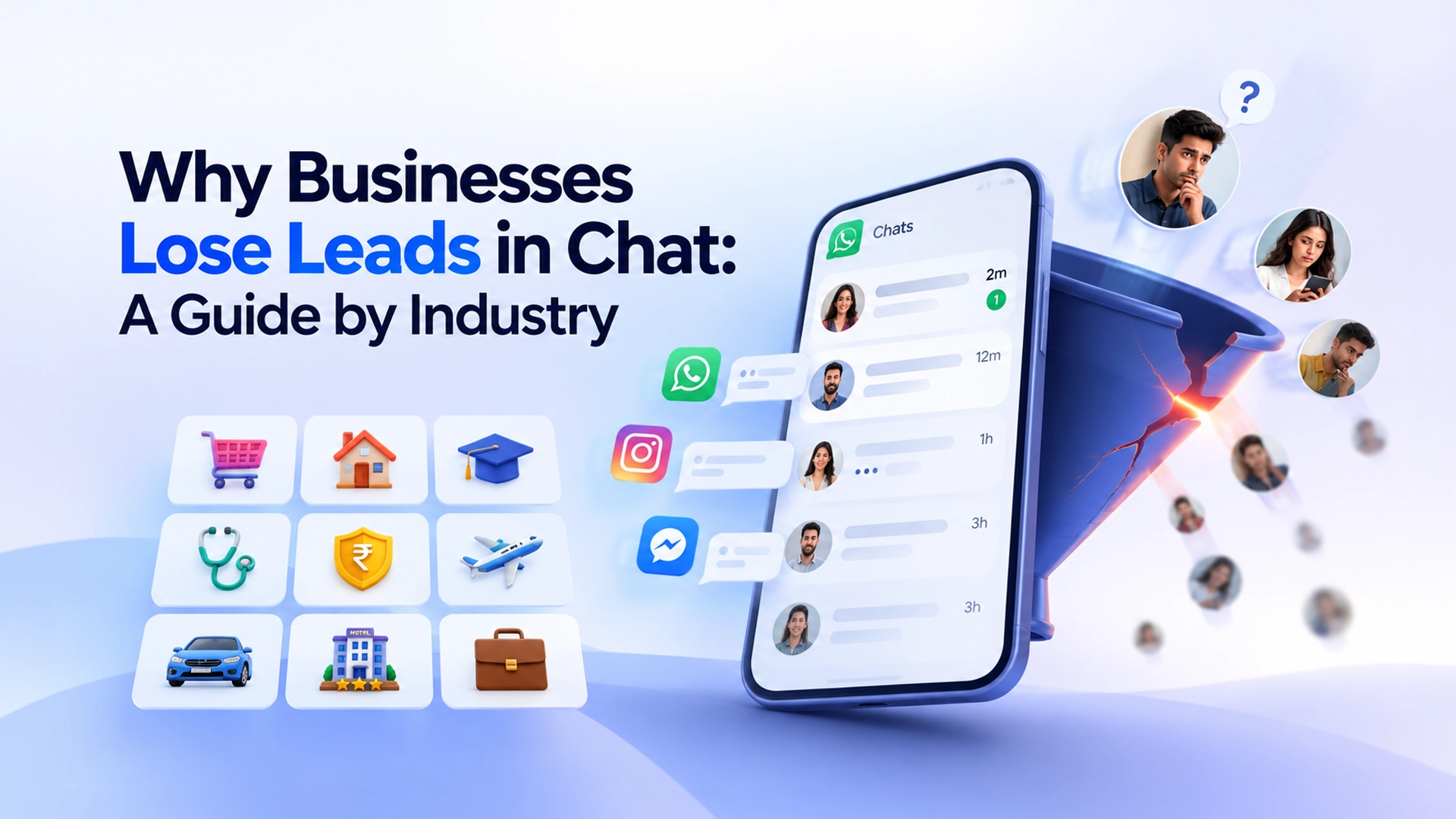
The same pattern shows up in longer, higher-value B2B sales cycles too — see why B2B deals stall in WhatsApp follow-up, and in the comparison-shopping behavior we describe in why hotel and travel bookings go cold on WhatsApp. See the full pattern across nine industries in why businesses lose leads in chat.
Want to see what this looks like for your team? Start a free trial — no card required, set up in minutes.