

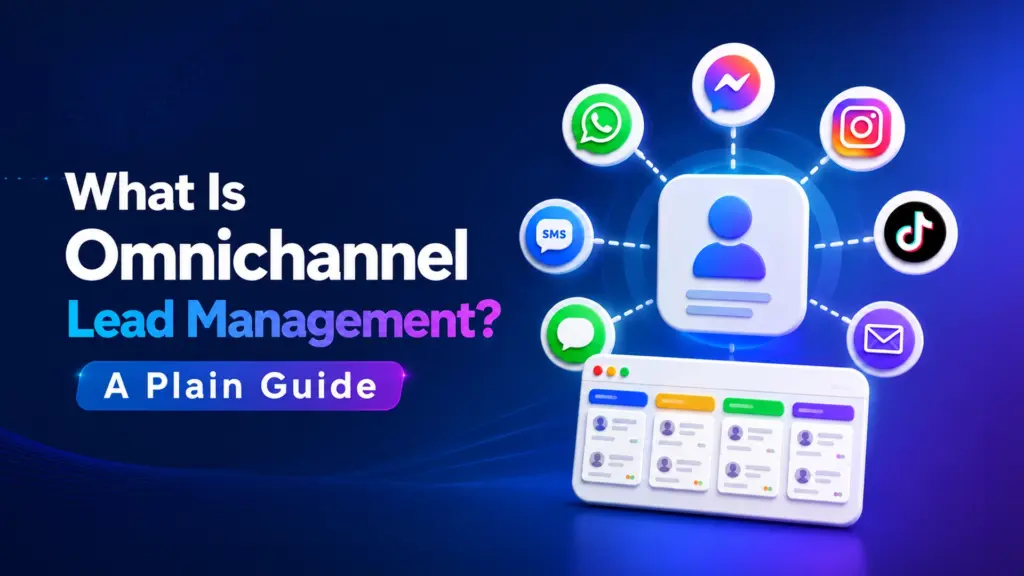
Omnichannel lead management means catching every customer conversation — WhatsApp, Messenger, Instagram, SMS, email in one place, instead of checking five separate apps and hoping nothing slips through. It’s the difference between a business that knows the moment someone reaches out, no matter which app they used, and one that finds out three days later that a lead went cold in an inbox nobody was watching.
The term gets used loosely, so it’s worth being precise about what it actually involves — and what it doesn’t.
What omnichannel lead management actually means
It’s not the same as “multichannel.” A multichannel business has a Facebook Page, an Instagram account, and a WhatsApp number — three separate places customers can reach them, each checked separately, often by different people, with no shared record between them. Omnichannel means those three channels feed into one place, with one history per customer, regardless of which app they happened to message from.
The practical test: if a customer messages you on Instagram today and follows up on WhatsApp tomorrow, does whoever answers the second message know about the first conversation? If yes, you have an omnichannel system. If no, you have several channels that happen to exist near each other.
The core pieces of a real omnichannel lead management system
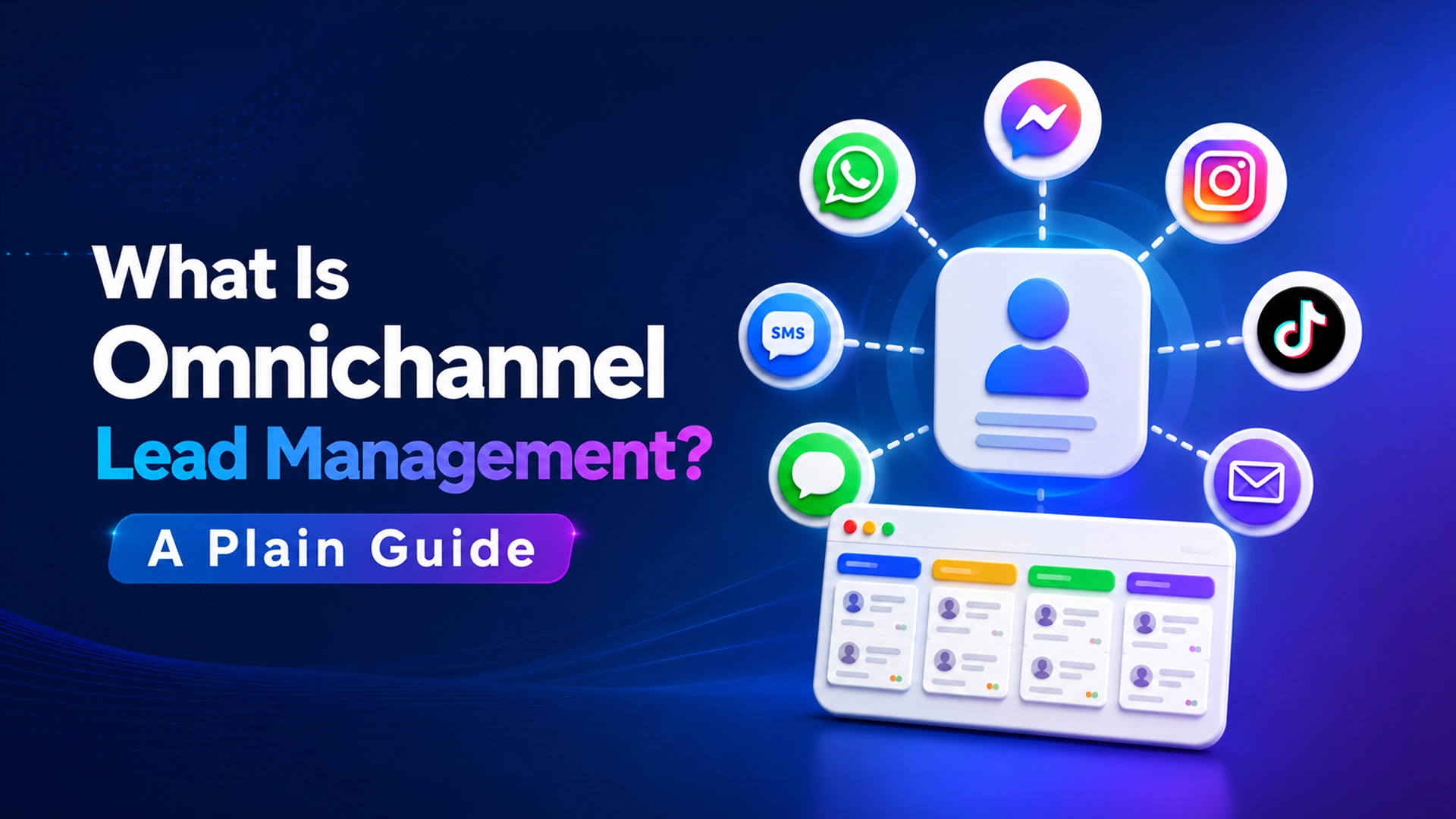
- A unified inbox. Every channel — WhatsApp, Messenger, Instagram, TikTok, SMS, email — lands in one threaded view, with the customer’s full history attached, so anyone on the team can pick up a conversation with context.
- An AI first responder, with a human handoff. Instant replies to the questions that repeat constantly — price, hours, availability — with a clean handoff to a person the moment the conversation needs real judgment, and a way for a human to take over at any point.
- A visual pipeline. Every conversation tagged by stage — new inquiry, qualified, negotiating, closed — so nothing depends on one person remembering where things stood.
- Broadcast and nurture tools. A way to re-engage people who went quiet, instead of losing them the moment they stop replying.
- Attribution. A line connecting the ad, campaign, or channel that brought the lead in, to whether it actually converted — not just how many clicks it got.
Miss any one of these and the system tends to break down somewhere specific: no unified inbox means messages still get missed — research citing Salesforce found 90% of customers expect a reply to a social inquiry within ten minutes, while the average business takes over ten hours on Instagram alone; no AI-plus-handoff means either slow replies or a robotic chatbot that frustrates people; no pipeline means “who’s following up on this” becomes a guessing game; no attribution means marketing spend keeps flowing to whatever looks good on paper rather than what actually converts.
Common omnichannel lead management misconceptions
- “It’s just a chatbot.” A chatbot alone, with no human handoff and no pipeline behind it, tends to frustrate customers on anything beyond the simplest question. The AI piece only works well as part of a larger system.
- “It’s the same as a help desk tool.” Help desk software is usually built for support tickets after a sale. Lead management is built for the conversation before a sale — qualifying, nurturing, and converting a prospect, not just resolving a complaint.
- “More channels connected automatically means better coverage.” Connecting five channels to five separate inboxes that nobody consolidates doesn’t fix the underlying problem — it just adds more places for a message to get lost.
Frequently asked questions
Is omnichannel lead management only for large companies?
No — the businesses that benefit most are often small teams, because they have the least slack to absorb a missed message. A single missed inquiry matters more to a five-person team than a five-hundred-person one.
What’s the difference between omnichannel and multichannel?
Multichannel means being present on several platforms, checked separately. Omnichannel means those platforms feed into one shared inbox and history, so no conversation depends on which app a customer happened to use.
Do I need a human team if I have an AI assistant?
Yes, for anything beyond routine questions. The AI’s job is to handle the repetitive first-contact questions instantly and hand off cleanly — not to replace a human for real qualifying conversations or judgment calls.
How is this different across industries?
The core system is the same, but the trigger and the stakes differ — see how it plays out specifically for real estate, healthcare, or e-commerce.
Why this matters right now
Customer communication has shifted from phone and email to chat across almost every industry we’ve looked at — see our full guide to why businesses lose leads in chat, by industry — and that shift means the old model of “check your inboxes throughout the day” no longer holds up against how fast a prospect’s attention moves on. If you’re comparing platforms for this, see our WhatsApp CRM buyer’s checklist.
Leads Nimble is built around exactly this definition: one inbox across WhatsApp, Messenger, Instagram, TikTok, SMS and email, an AI assistant that responds instantly and hands off cleanly, a visual pipeline, broadcast tools, and ad attribution — the full omnichannel lead management system, not just one piece of it.
Want to see what this looks like for your business? Start a free trial — no card required, set up in minutes.



Discussion