Tag: Response time

  • Missed Message Calculator: How Much Is Your Inbox Losing?

    Missed Message Calculator: How Much Is Your Inbox Losing?

    Last updated: 5 November 2026 · By Leads Nimble Team (a product of Luminous Labs, Dhaka)

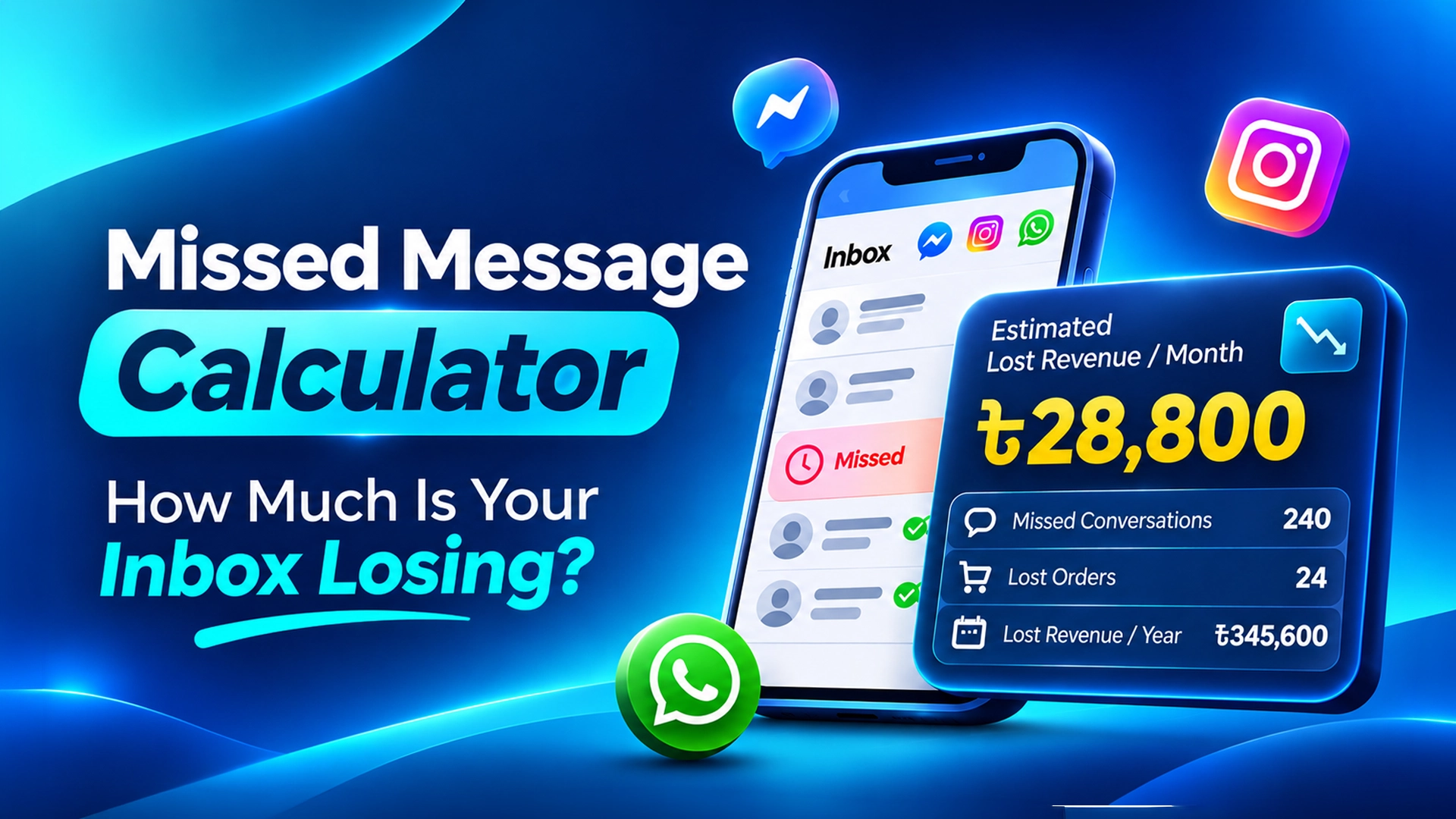
    Facebook inbox lost sales are easy to estimate. Multiply your daily messages by 30, then by the share you miss, then by your conversion rate and average order value. A page getting 40 messages a day that misses one in five can lose around ৳28,800 a month. Use the calculator below for your own numbers.

    Key takeaways

    • Formula: messages per day × 30 × % missed × conversion rate × average order value.
    • A “missed” message is one never answered, or answered after the buyer has moved on.
    • Even small leaks add up: missing 20% of 40 daily chats is 240 lost conversations a month.
    • Night, Friday and Eid-rush messages are where most Bangladeshi pages leak.
    • Fix the leak in this order: measure it, add instant answers for common questions, then add AI and team routing.

    How much is your Facebook inbox losing? Try the calculator

    Enter your own numbers. Use honest estimates; you can refine them later with the steps further down.

    New customer conversations on your page (Messenger + Instagram + WhatsApp).
    Never replied, or replied after several hours.
    Out of 100 answered conversations, how many become an order?
    Average Taka value of one order or booking.
    Estimated revenue lost per month
    ৳0
    Missed conversations / month0
    Lost orders / month0
    Lost revenue / year৳0

    This is an estimate of revenue, not profit. To see lost profit, multiply the result by your margin. For example, at a 25% margin, ৳28,800 of lost revenue is about ৳7,200 of lost profit.

    What is the missed message formula?

    The missed message revenue formula estimates the sales value of customer conversations your business never converts because nobody replied in time.

    Monthly lost revenue = Messages per day × 30 × % missed × Conversion rate × Average order value

    Each input has a plain meaning:

    • Messages per day is new customer conversations, not total messages. One customer sending five lines counts once.
    • % missed is the share of those conversations that got no reply, or a reply after the buyer stopped caring.
    • Conversion rate is the share of answered conversations that turn into an order, booking or payment.
    • Average order value (AOV) is the average Taka value of one sale.

    The formula assumes missed chats would have converted at your normal rate. That's a fair middle estimate. Some missed chats were never serious; others were ready-to-buy customers who simply went to the next page.

    Worked examples in BDT

    Here is the formula applied to four typical Bangladeshi business types. The inputs are illustrative, not survey data. Swap in your own.

    BusinessMsgs/day% missedConv. rateAOV (BDT)Lost orders/moLost revenue/mo
    Small clothing page (COD)4020%10%৳1,20024৳28,800
    Growing cosmetics f-commerce15025%8%৳1,80090৳162,000
    Diagnostic clinic (bookings)3030%15%৳1,50040.5৳60,750
    Study abroad agency (service fee)2020%3%৳50,0003.6৳180,000

    Notice the last row. Low message volume and a low conversion rate still produce the biggest loss, because each sale is worth a lot. High-ticket businesses, such as agencies and real estate, can least afford a slow inbox. See how this plays out for real estate leads on WhatsApp and Messenger.

    Example worked step by step

    1. 40 messages a day × 30 days = 1,200 conversations a month.
    2. 1,200 × 20% missed = 240 missed conversations.
    3. 240 × 10% conversion = 24 orders that never happened.
    4. 24 orders × ৳1,200 = ৳28,800 lost revenue a month.
    5. ৳28,800 × 12 = ৳345,600 a year.

    How do you find your real numbers?

    Guesses are fine to start. One week of tracking makes the result much more reliable.

    1. Count conversations. In Meta Business Suite's inbox, count new conversations for 7 days across Messenger, Instagram and WhatsApp. Divide by 7.
    2. Count misses. Each morning, count chats from the previous day that were unanswered or answered more than 3–4 hours later. Divide the weekly total by total conversations.
    3. Find conversion rate. Count orders that came from chats that week. Divide by answered conversations.
    4. Find AOV. Total chat-order revenue divided by number of chat orders. Use the price after discount, before delivery charge.
    5. Plug into the calculator and save the result. Re-check every month.

    Why do Facebook pages miss so many messages?

    Most pages don't ignore customers on purpose. The leaks are structural.

    Messages arrive when nobody is working

    Many Bangladeshi shoppers browse late at night. Messages sent at 11 pm wait until 10 am. By then, the buyer has often ordered from a page that answered.

    Peak days overwhelm the team

    Eid, Pohela Boishakh, 11.11 and big sale days can multiply inbox volume. A team that copes on normal days falls hours behind.

    The same five questions eat the day

    "Dam koto?", "delivery charge koto?", "COD hobe?", "size ache?". Staff answer these hundreds of times, while serious buyers wait in the queue.

    Comments never reach the inbox

    Customers who comment "price?" on a post are leads too. If nobody moves them to the inbox, they are invisible misses.

    Several channels, no single view

    Messenger on one laptop, WhatsApp on a staff phone, Instagram on the owner's phone. Chats fall between them. We covered this in stop losing sales in Facebook and Instagram DMs.

    Does reply speed really change sales?

    Yes, and the evidence is old and consistent. An audit published in Harvard Business Review (Oldroyd, McElheran and Elkington, 2011) found firms that contacted leads within an hour were nearly seven times as likely to qualify them as firms that waited an hour longer. The full citation is listed in BYU ScholarsArchive.

    That study looked at US web leads, not Facebook chats in Dhaka. But the logic carries over: a buyer messaging three pages will usually order from the first one that gives a clear answer. For realistic reply-time targets, see our guide to Facebook page response time.

    How to reduce missed messages: free and paid options

    OptionCostWhat it fixesLimit
    Meta instant reply + FAQsFreeAcknowledges every message; answers fixed questionsCan't answer price or stock questions intelligently
    Saved repliesFreeFaster typing for staffStill needs a human online
    Extra staff shiftSalaryCovers nights or peak daysExpensive; hard to scale on Eid
    AI assistant + unified inboxFree plan or monthly fee24/7 Bangla answers, all channels in one place, follow-upsNeeds a good knowledge base and human handoff

    Start with the free Meta tools; our free Facebook page auto reply guide shows the setup. When the calculator shows a loss larger than a CRM subscription, upgrading is simple arithmetic.

    How Leads Nimble helps close the gap

    Leads Nimble is an AI sales CRM and unified inbox built in Dhaka. It puts Messenger, Instagram, WhatsApp, website chat and Telegram in one inbox, so no channel is forgotten. Comment automation helps move "price?" comments into conversations.

    Its AI assistant answers 24/7 in Bangla and English using your own prices, delivery charges and FAQs, and hands complex chats to a human. Every chat becomes a lead in a pipeline with follow-up reminders, so a slow reply doesn't become a lost buyer.

    You can test it on the free forever plan: $0, no credit card, one user, one Messenger page and 500 AI credits a month. Paid plans add seats, channels and credits, billed in Taka in Bangladesh. See the pricing page or book a demo and bring your calculator result.

    Frequently asked questions

    How do I calculate lost sales from missed Facebook messages?

    Multiply messages per day by 30 to get monthly conversations. Multiply that by the percentage you miss, then by your conversion rate, then by your average order value in Taka. For example, 40 messages a day, 20% missed, 10% conversion and a ৳1,200 order gives about ৳28,800 of lost revenue per month.

    What counts as a missed message?

    A missed message is a new customer conversation that got no reply, or a reply so late the customer had already lost interest or bought elsewhere. For most f-commerce pages, a reply more than a few hours later is effectively missed. Instant auto-replies that only say "we'll get back to you" do not count as a real answer.

    Is the calculator result revenue or profit?

    It is revenue. To estimate lost profit, multiply the result by your gross margin. If your margin is 25%, a ৳28,800 revenue loss means roughly ৳7,200 of lost profit per month. Remember that lost customers also lose you future repeat orders, which this simple formula does not include.

    What is a good conversion rate for Facebook page messages?

    There is no reliable published benchmark for Bangladeshi Facebook pages, and rates vary a lot by product, price and ad quality. The best number is your own. Track one week of chats and orders, divide orders by answered conversations, and use that figure. Recheck it monthly as your ads and offers change.

    How can I stop missing messages at night?

    Set up Meta's free instant reply and FAQ answers first, so every message gets an acknowledgement. For real answers at night, use an AI assistant trained on your prices, delivery charges and policies, with human handoff for complex chats. A unified inbox also helps by bringing Messenger, Instagram and WhatsApp into one queue.

    Does replying faster really increase sales?

    Research suggests yes. A 2011 Harvard Business Review study of online leads found firms responding within an hour were nearly seven times as likely to qualify a lead as those responding an hour later. Customers messaging several Facebook pages usually buy from whichever page answers clearly first.

  • Facebook Page Reply Time in Bangladesh: Benchmarks and Fixes

    Facebook Page Reply Time in Bangladesh: Benchmarks and Fixes

    Last updated: 5 November 2026 · By Leads Nimble Team (a product of Luminous Labs, Dhaka)

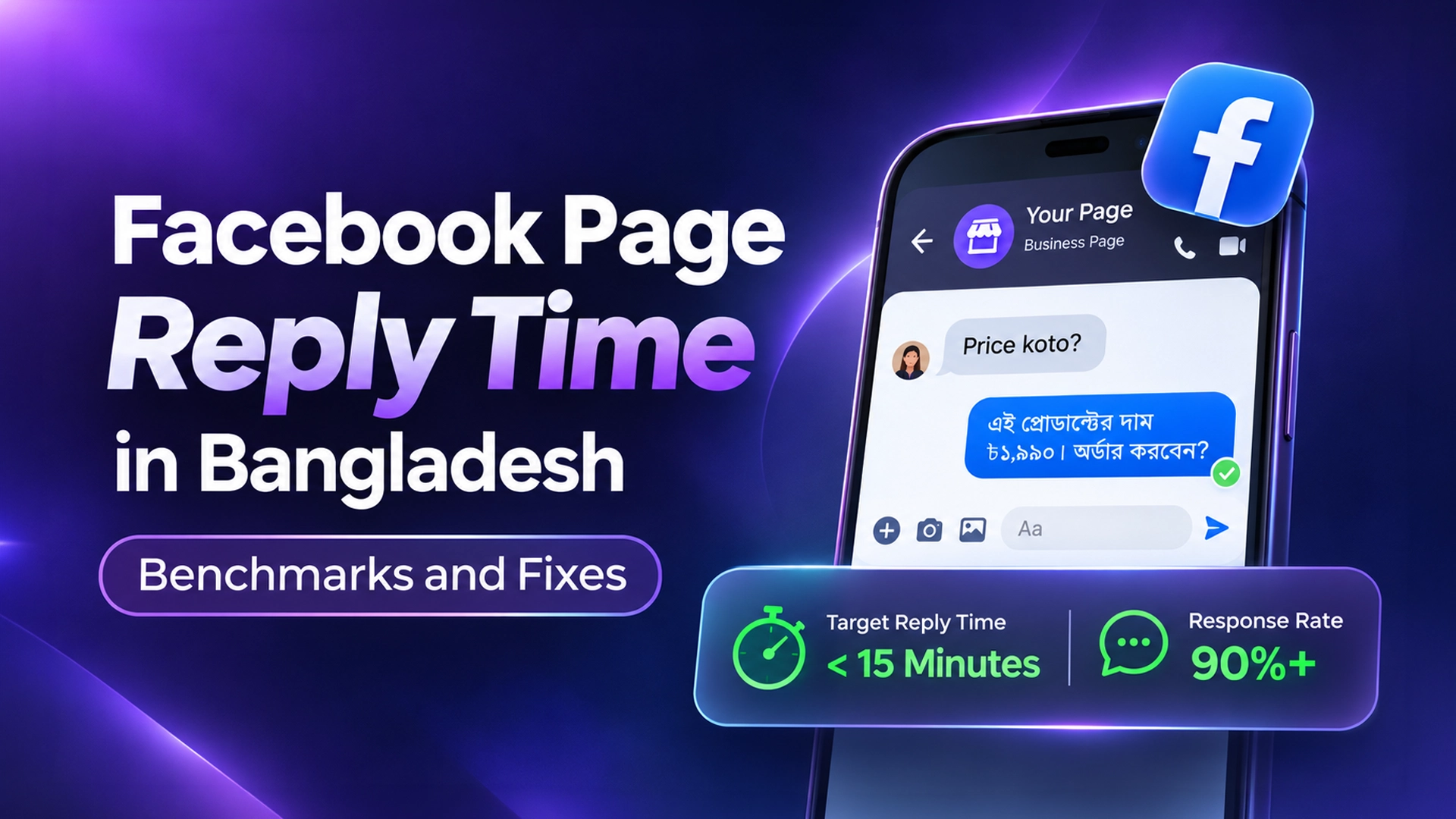
    A good Facebook page response time in Bangladesh is under 15 minutes during business hours, with at least 90% of messages answered. Those are the targets historically linked to Meta’s “Very responsive to messages” badge. For sales leads, aim even faster: research shows replying within an hour dramatically raises your chances of closing.

    Key takeaways

    • Target: answer 90%+ of new messages, with a typical reply under 15 minutes. Under 5 minutes is better for f-commerce.
    • Meta measures response rate and response time from your first reply to new conversations only.
    • Instant replies and away messages have been reported as not counting toward these metrics. A real answer does.
    • Published research found leads contacted within an hour were far more likely to be qualified than leads contacted later.
    • Hit the target with a rota, saved answers, a single inbox and an AI assistant for nights and peaks.

    What is Facebook page response time?

    Facebook page response time is how long your page typically takes to send its first reply to a new message. Meta shows it to visitors, for example as “Typically replies within an hour”, on your page and in Messenger.

    Response rate is the percentage of new messages your page replies to. Together, these two numbers tell customers whether messaging you is worth it.

    How does Meta calculate them?

    Meta has adjusted the details over the years, and its help pages are the final word. Reporting by Blog du Modérateur (2018) described the method like this:

    • Only the first message in a new conversation counts. Replying many times in one chat doesn’t improve the score.
    • The window is roughly the last 30 days (or your last 10 messages if volume is low).
    • Response time is the average of your fastest 90% of replies, so a few very slow ones don’t wreck it.
    • Excluded: instant replies, away messages, spam, and messages received while the page was set to “Away”.
    • Included: replies sent by a person or through an API, such as a connected chatbot or CRM.

    The practical lesson: an automatic “Thanks, we’ll reply soon” greeting is useful for the customer, but it does not make your page look faster. A real answer does.

    What does the “Very responsive to messages” badge require?

    When Meta launched page response metrics in 2015, the “Very responsive to messages” badge went to pages with a response rate of at least 90% over the previous seven days. TechCrunch reported a fast median response time as the second condition. Many social media agencies have since quoted the target as 15 minutes.

    Meta does not publish a current public threshold that we could verify for 2026, and it has changed page features often. So treat 90% and under 15 minutes as a sensible target, not a guaranteed badge formula. If your page meets it, customers see a fast “typically replies” label either way.

    What is a good response time benchmark for Bangladeshi pages?

    We won’t invent a survey of Bangladeshi pages. No reliable public one exists that we know of. Instead, here are practical targets, built from Meta’s historic badge criteria and published lead-response research.

    Business typeTarget first reply (business hours)Outside hoursWhy
    F-commerce (clothing, cosmetics, gadgets)Under 5 minutesAI or instant answer to price, delivery and CODBuyers message several pages and order from the first clear answer
    Food and cloud kitchensUnder 2–3 minutesClear closed message with next opening timeHunger doesn’t wait
    Clinics and diagnosticsUnder 15 minutesBooking options and emergency guidancePatients compare availability, not just price
    Study abroad agenciesUnder 15 minutesAI collects country, intake and test scoreHigh-value leads, often messaging many agencies
    Real estateUnder 15 minutes; call within the hourAI shares project details and books a callbackEach lead is worth a lot; speed signals seriousness
    B2B and servicesUnder 1 hourAcknowledge and set expectationsLonger decisions, but first contact still matters

    Why does response time matter so much for sales?

    Because interest decays fast. In an audit published in Harvard Business Review in 2011, researchers found that only 37% of 2,241 US companies answered online leads within an hour, and the average response took 42 hours.

    The same research reported that firms contacting a lead within an hour were nearly seven times as likely to qualify it as those that waited an hour longer. Firms that waited a day or more did far worse still.

    That study was about US web forms, not Messenger. But a Dhaka shopper asking “dam koto?” on three pages behaves the same way. The first clear answer usually wins the order. Our missed message calculator shows what slow replies cost in Taka.

    How to check your page’s response time

    1. Open Meta Business Suite on desktop or the mobile app.
    2. Go to the Inbox and look for your page’s messaging insights or response metrics. Menu names change, so search “response time” in Meta’s help if you can’t find it.
    3. Note your current response rate and response time.
    4. Check how your page appears to customers: open it from a personal account and look for the “Typically replies…” label.
    5. Write the numbers down weekly. Improvement you don’t measure tends not to happen.

    How to hit a 15-minute (or faster) reply time

    1. Set clear working hours and an honest away state

    Messages received while your page is set to away have been reported as excluded from response metrics. Use it for genuine off-hours, such as late night or Friday prayers, not to hide a slow team.

    2. Build a staff rota for peak hours

    Most pages have predictable peaks: after ads go live, lunch time, and late evening. Put someone on the inbox for those windows, especially during Eid and sale campaigns.

    3. Prepare saved replies for the top 10 questions

    Price, size, colour, delivery charge inside and outside Dhaka, COD, bKash or Nagad payment, delivery time by Pathao, Steadfast or RedX, return policy. Ready answers cut reply time from minutes to seconds. For ideas, use our Bangla auto reply templates.

    4. Bring all channels into one inbox

    If Messenger, Instagram and WhatsApp are on different phones, the slowest phone sets your real response time. A unified inbox puts every new chat in one queue.

    5. Route chats to the right person

    Sales questions to sales, complaints to support. Assignment stops the “I thought you were answering it” problem.

    6. Add an AI assistant for nights and spikes

    An AI assistant trained on your real prices and policies can give a full answer at 2 am. Because API-connected replies have been reported to count as real replies, this can help your metrics as well as your sales. Always include a human handoff for complaints and unusual questions.

    7. Review slow chats every week

    Pick five slow conversations each week and ask why. Usually it’s a missing answer in your saved replies or a gap in the rota. Fix that one cause.

    Free tools vs a CRM for faster replies

    ToolCostHelps response time?Limits
    Meta instant replies and FAQsFreeHelps customers; reported not to count in metricsFixed answers only
    Saved replies in Business SuiteFreeYes, speeds up staffNeeds someone online
    Staff rotaSalaryYesCostly at night and on holidays
    Unified inbox + AI CRMFree plan or monthly feeYes, 24/7 real answers across channelsNeeds a good knowledge base and setup

    Start with the free tools. Our free Facebook page auto reply guide covers setup step by step.

    How Leads Nimble helps you reply faster

    Leads Nimble is an AI sales CRM and unified inbox made in Dhaka by Luminous Labs. It brings Messenger, Instagram, WhatsApp, website chat and Telegram into one inbox, with team routing, roles and a mobile app for replying on the go.

    Its AI assistant answers 24/7 in Bangla and English from your own knowledge base: products, prices, delivery charges and FAQs. It qualifies leads and hands them to a human when needed. Every conversation becomes a lead with follow-up reminders. See all features.

    Try it free: the free forever plan includes one user, one Messenger page, 500 AI credits a month and no credit card. Compare paid plans on the pricing page or book a demo.

    Frequently asked questions

    What is a good response time for a Facebook page?

    Aim to answer at least 90% of new messages, with a typical first reply under 15 minutes during business hours. Those figures match the targets historically linked to Meta’s “Very responsive” badge. For f-commerce pages, under five minutes is better, because shoppers often message several pages and buy from whoever answers clearly first.

    How do I get the “Very responsive to messages” badge?

    When Meta introduced it in 2015, the badge required a response rate of at least 90% and a fast response time over the previous seven days. Meta has not published a current threshold we could verify for 2026. Aim for 90% and under 15 minutes, use real replies rather than auto-greetings, and set your page to away only during genuine off-hours.

    Do instant replies count toward Facebook response time?

    Reportedly not. Published explanations of Meta’s calculation say instant replies and away messages are excluded from response rate and response time. Replies sent by a person, or through an API such as a connected chatbot or CRM, are counted. Instant replies are still worth using, because they reassure customers while a real answer is on its way.

    How is Facebook page response rate calculated?

    Response rate is the share of new conversations your page replies to. Based on published explanations, only the first message of a new conversation counts, over roughly the last 30 days. Spam, conversations you closed, and messages received while your page was marked away are excluded. Meta can change these rules, so check its help center for the latest.

    Does response time affect sales?

    Yes. A 2011 Harvard Business Review audit found only 37% of companies answered online leads within an hour, and that firms responding within an hour were nearly seven times as likely to qualify a lead as those waiting an hour longer. Messaging buyers in Bangladesh behave similarly: slow answers send them to competing pages.

    How can a small team reply faster without hiring?

    Prepare saved replies for your top ten questions, put all channels in one inbox, and cover peak hours with a simple rota. Then add an AI assistant trained on your prices and policies to answer nights and spikes, with handoff to a human for complaints. Review a few slow chats each week and fix their causes.