Tag: lead management

  • WhatsApp CRM Buyer’s Checklist: What to Look for Before You Switch

    WhatsApp CRM Buyer’s Checklist: What to Look for Before You Switch

    Use this WhatsApp CRM Buyer’s Checklist before you commit to a switch. Most businesses don’t research a WhatsApp CRM carefully the first time — they grab whatever comes up first, get it working, and only discover the gaps six months later when the team has outgrown it. That pattern shows up in the data too: roughly 40% of companies switch CRM platforms within their first two years, and limited functionality is the single most common reason cited. This checklist is meant to shortcut that: the questions worth asking before you commit, not after.
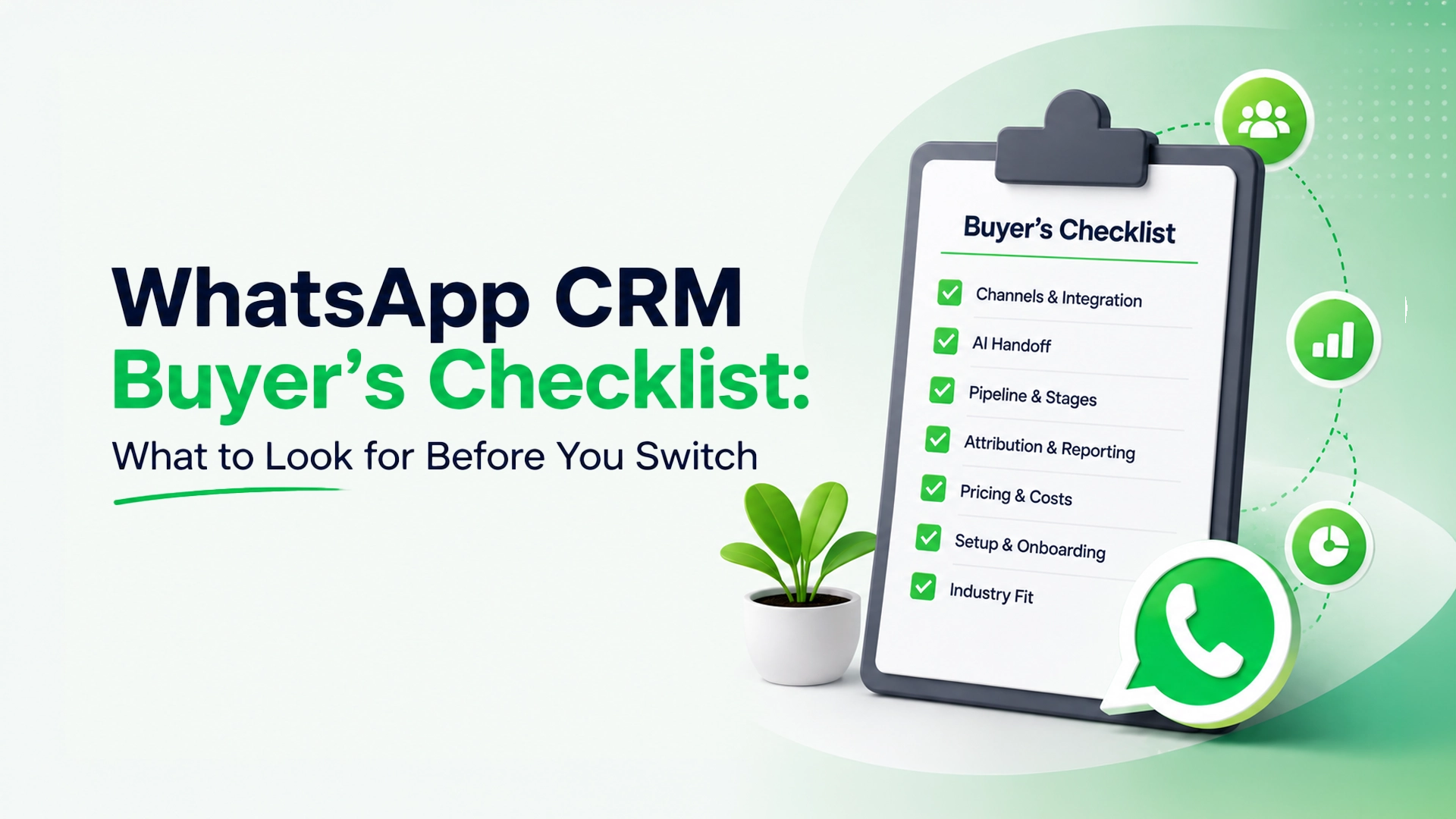
    WhatsApp CRM buyer's checklist before you switch tools
    This WhatsApp CRM buyer’s checklist covers seven questions worth asking before you switch.

    1. Which channels does it actually cover — not just advertise?

    WhatsApp is usually the anchor, but check whether Messenger, Instagram, TikTok, SMS, and email are genuinely integrated into the same inbox, or just listed on the pricing page as an add-on that needs separate setup. A tool that’s WhatsApp-only works fine until a lead messages you on Instagram instead — a scenario that happens constantly for businesses running ads on Meta’s platforms.

    2. Does the AI actually hand off to a human, or just loop?

    Almost every tool claims “AI automation” now. The real question is what happens when the AI hits a question it can’t answer. A good system hands off cleanly to a person with full conversation context and lets a human take over at any point. A weak one either loops the customer back to a menu or has no handoff at all, which is worse than no AI.

    3. Is there a real pipeline, or just tags?

    Tags tell you a lead’s status at a glance. A pipeline shows you where every lead sits in a process — new inquiry, qualified, negotiating, closed — and lets your team act on stalled deals instead of just labeling them. If your sales process has more than two steps, a tagging system alone won’t hold up.

    4. Can you see which ad or channel actually produced a sale?

    Plenty of tools track message volume. Fewer connect a completed sale or signed deal back to the specific ad, campaign, or channel that produced it. Without that, your ad budget optimizes for clicks and replies, not revenue.

    5. What’s the actual pricing model, and what’s excluded?

    WhatsApp CRM pricing is notoriously easy to misread. Look specifically for: per-user fees that scale awkwardly as your team grows, per-message or per-conversation charges layered on top of the base plan, and separate WhatsApp Business API costs that aren’t included in the headline price. A plan that looks cheap at 2 users can get expensive fast at 10.

    6. How long does setup actually take?

    Some platforms need a developer to configure webhooks and API connections before the first message can be sent. Others are usable within an afternoon. If you don’t have technical resources in-house, ask specifically about setup time before buying — not after.

    7. Does it fit your industry’s actual workflow?

    A tool built primarily for Shopify order confirmations will feel awkward for a real estate pipeline, and vice versa. Look for case studies or feature sets that match your specific use case — e-commerce, real estate, healthcare, or agencies managing several clients at once — rather than a generic “works for everyone” pitch.

    Common mistakes when choosing

    • Picking based on brand recognition alone. The best-known tool in the space isn’t automatically the best fit for your channel mix or budget.
    • Ignoring per-message costs during the trial. A free trial often waives usage-based fees that show up in the first real invoice.
    • Not testing the AI-to-human handoff before committing. This is the single feature most likely to frustrate customers if it’s done poorly, and it’s rarely obvious from a features page.
    • Choosing the cheapest plan and outgrowing it in months. It’s usually cheaper to pay slightly more up front for a system with room to grow than to migrate contact history and automations later.

    Frequently Asked Questions WhatsApp CRM Buyer’s Checklist

    Do I need a WhatsApp Business API account, or does the CRM handle that?

    It varies by provider — some include API setup in the price, others expect you to arrange it separately. Confirm this before signing up, since a missing API connection can stall onboarding by days.

    Is a cheaper, WhatsApp-only tool ever the right choice?

    Yes — if your leads genuinely only ever contact you on WhatsApp and you don’t run ads on Instagram or Facebook, a simpler, WhatsApp-first tool can be a reasonable, lower-cost fit.

    How important is the pipeline feature really?

    It depends on your sales cycle length. A same-day purchase decision (like most retail DMs) needs less pipeline structure than a multi-week decision (like real estate, B2B, or financial services), where tracking stage and follow-up matters far more.

    Leads Nimble covers all seven of these directly: WhatsApp, Messenger, Instagram, TikTok, SMS and email in one inbox, an AI assistant with a clean human handoff, a visual pipeline, ad attribution tied to actual conversions, transparent pricing, and same-day setup. See how it stacks up specifically against other platforms in our comparison of Leads Nimble, Kommo, Zoko, and Wati, or the full guide to why businesses lose leads in chat for industry-specific detail.

    Want to see it against your own checklist? Start a free trial — no card required, set up in minutes.
  • Qualifying Loan & Insurance Leads Without Losing Them to Slow Follow-Up

    Qualifying Loan & Insurance Leads Without Losing Them to Slow Follow-Up

    Response time decides more loan and insurance leads than price does. Someone fills out a form on your loan or insurance landing page. Ten seconds later, they’ve closed the tab and started filling out the same form on a competitor’s site — sometimes two or three more. In this industry, that’s not impatience. It’s how shopping for a loan or a policy normally works.

    Whoever calls back first usually gets the application. Not the lender with the best rate. Not the agency with the best reviews. The one who showed up while the prospect was still paying attention.

    Qualifying loan and insurance leads before slow follow-up loses them
    Insurance leads are almost always shopping several providers at once — speed is the lever.

    Why loan and insurance leads are uniquely time-sensitive

    Two things make this vertical harder than most. First, prospects are almost always comparison shopping by default — nobody requests one insurance quote or one loan estimate; they request several at once, on purpose. Second, in a lot of loan and insurance lead generation, the same lead is quite literally sold or shared to multiple agents or brokers at the same time, so several people are racing to be the first to call.

    Industry research on this is blunt: insurance companies reportedly lose as much as 84% of leads to quote abandonment, a rate significantly higher than the roughly 70% cart abandonment average typical of e-commerce, with most of that drop-off happening within the first day or two after a quote request. Response-time studies going back to MIT’s original Lead Response Management research (and repeated many times since, including by Harvard Business Review) consistently find that contacting a lead within minutes rather than hours dramatically changes the odds of ever reaching them at all, let alone converting them.

    For a loan officer or insurance agent, that means “I’ll call them back after lunch” is often the same as losing the lead entirely. Insurance leads do not wait, and neither do loan applicants — both have already asked someone else the same question.

    Where financial services teams actually lose insurance leads

    • Leads land in a personal WhatsApp or a shared inbox nobody’s watching in real time. A form submission from a Facebook or Google ad turns into a message that sits until someone happens to check.
    • There’s no shared view of where a prospect actually is. Has this person already been quoted? Are they waiting on a document? Did someone already promise them a callback today? Without a shared pipeline, two team members can easily contact the same lead with two different answers.
    • Record-keeping is scattered. In a regulated, trust-sensitive industry, being able to show exactly what was said, when, and by whom matters and that’s hard to reconstruct from a personal phone’s chat history after the fact.
    • Nurture stops the moment a lead goes quiet. Someone who wasn’t ready to switch providers today isn’t a dead lead — but without a system to follow up before a renewal date or a rate change, that opportunity just evaporates.
    • Nobody can trace which campaign is actually producing signed applications — as opposed to just form fills — so ad budget doesn’t necessarily go where it should.

    What actually fixes slow follow-up on insurance leads

    1. One inbox for every channel a lead might use — WhatsApp, Messenger, Instagram, SMS, and email — so a new inquiry is never sitting unseen in an app nobody’s monitoring.
    2. An AI assistant that acknowledges instantly, 24/7, handling the first round of routine questions (loan amount, coverage type, timeline) and handing off cleanly to a licensed agent the moment the conversation needs a real qualifying discussion — with a human always able to take over.
    3. Built-in voice calling, so the moment a lead looks serious, someone can call directly from the same platform instead of losing minutes switching tools.
    4. A visual pipeline shared across the team, so every prospect’s stage — quoted, documents pending, awaiting decision — is visible to everyone, not locked in one person’s head or inbox.
    5. A full, searchable conversation record, making it far easier to confirm what was communicated and when — useful in an industry where that kind of clarity matters.
    6. Broadcasts for nurture, so leads who weren’t ready this month hear from you again before a renewal date or rate change — instead of only when they happen to think of you.
    7. Attribution tied to actual signed business, not just form submissions, so marketing spend follows what converts.

    This is the specific gap Leads Nimble is built to close for loan officers, insurance agents, and financial services teams: one inbox across every channel a prospect uses, an AI assistant that responds instantly and hands off cleanly, built-in outbound calling, a shared pipeline, and ad attribution — all logged in one place instead of scattered across personal phones and separate tools.

    A quick self-audit on your insurance leads

    • If a quote request comes in at 7 p.m., how long before someone responds?
    • Can anyone on your team currently see, in one place, every lead’s stage and what’s already been discussed?
    • If a client disputes what they were told, how quickly could you pull up the actual conversation?
    • Do you know which ad or campaign produced your last five signed applications — or just which one had the most clicks?

    In a market where the same prospect is talking to several providers at once, the fastest, clearest responder usually wins the business. That is the whole argument for treating insurance leads as a speed problem rather than a pricing one. The fastest responder wins — not necessarily the best rate.

    The same pattern shows up in longer, higher-value B2B sales cycles too — see why B2B deals stall in WhatsApp follow-up, and in the comparison-shopping behavior we describe in why hotel and travel bookings go cold on WhatsApp. See the full pattern across nine industries in why businesses lose leads in chat.

    Want to see what this looks like for your team? Start a free trial — no card required, set up in minutes.
  • Why B2B Deals Stall in WhatsApp Follow-Up?

    Why B2B Deals Stall in WhatsApp Follow-Up?

    In B2B, WhatsApp lead response time is the difference between a closed deal and a cold one. In most of the world, WhatsApp isn’t a side channel for B2B sales — it’s the main one. Across India, Southeast Asia, the Middle East, Latin America, and Africa, business buyers routinely expect to negotiate, clarify, and even close deals over WhatsApp rather than email. Which means when a B2B deal stalls, the cause is often mundane: a follow-up question sat unanswered for four days, buried among two hundred other chats on a rep’s personal phone.

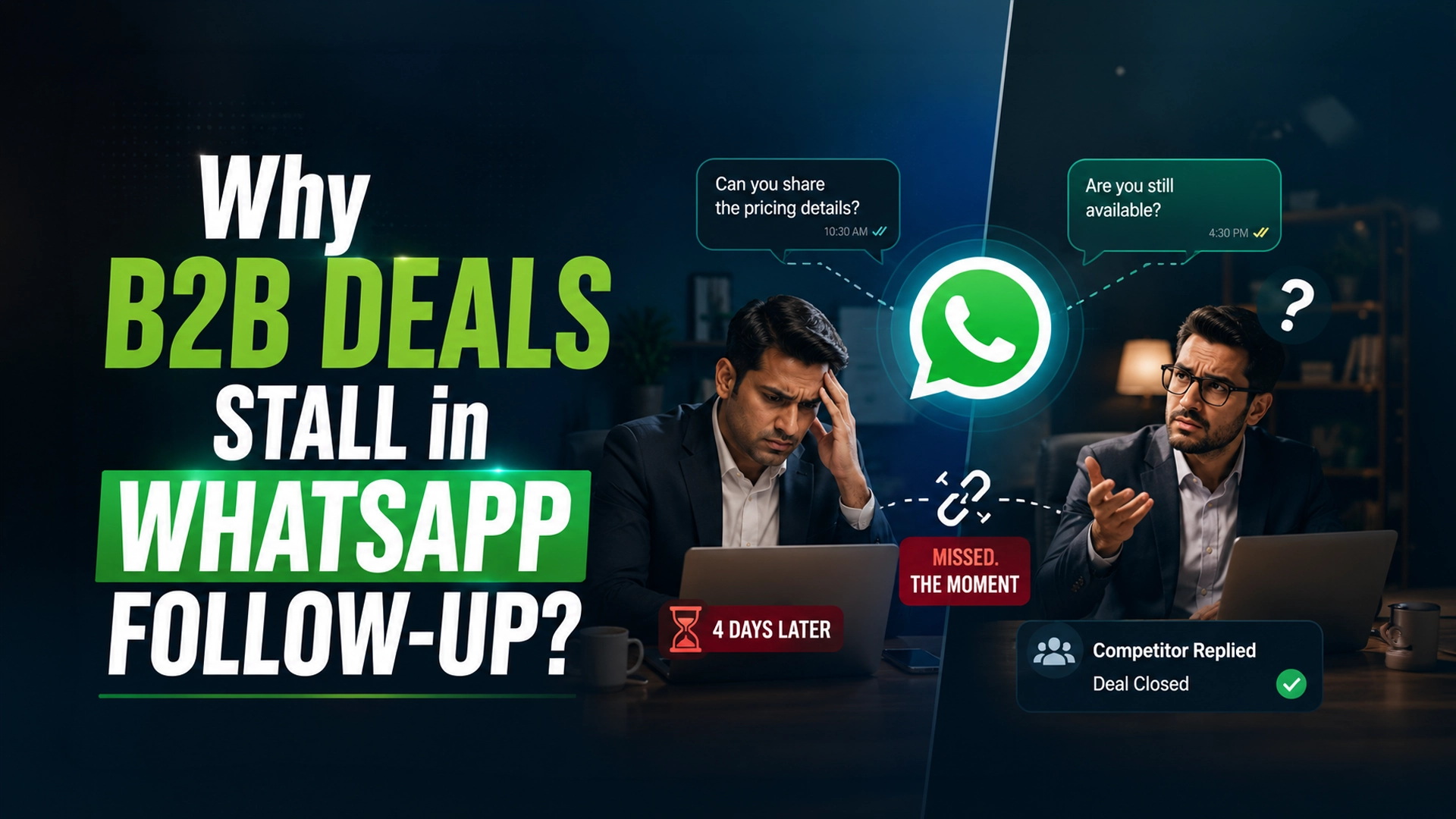
    Here’s how it usually happens: a prospect messages a supplier after a demo with one clarifying question about pricing or delivery. The rep who handled the demo is in back-to-back meetings. Nobody else on the team even knows the conversation exists. Four days later, the prospect has moved forward with a competitor who happened to reply the same afternoon — not because that competitor had a better product, just a faster reply.

    Why B2B deals stall when WhatsApp lead response time slips
    WhatsApp lead response time, not price, is usually what decides a stalled B2B deal.

    Why WhatsApp is the real B2B channel in most markets

    This isn’t a workaround businesses fall back on — it’s often the primary, expected channel. Analysis of B2B outreach performance has found that warm WhatsApp follow-up in markets like India and Southeast Asia can achieve 30–50% reply rates, compared to roughly 3–5% for a well-run cold email campaign — a gap driven largely by the fact that WhatsApp messages get read almost immediately, while most emails are opened within the first few hours, if at all.

    What the data says about WhatsApp lead response time

    Speed to first contact isn’t a soft metric in B2B — it shows up directly in win rates. Sales research on this consistently finds that businesses that make the fastest initial contact with a prospect are up to 50% more likely to close the deal, in a market where the average B2B sale is worth significantly more than a typical consumer purchase — which makes every stalled conversation considerably more expensive to lose.

    This tracks with the broader pattern we’ve described in qualifying loan and insurance leads without losing them to slow follow-up: high-value, high-consideration purchases are exactly where a slow reply costs the most, because the prospect has other, comparable options and no strong reason to wait.

    Where B2B teams actually lose deals in WhatsApp

    • Conversations live on individual reps’ personal phones, so if that rep is busy, in a meeting, or out sick, nobody else even knows the conversation exists.
    • There’s no shared record across a long sales cycle. B2B deals often involve weeks of back-and-forth — pricing, specs, procurement questions — and losing that context when a second person picks up the thread means starting over.
    • Follow-up depends entirely on one person remembering. A prospect who went quiet mid-negotiation rarely gets a deliberate nudge; they simply fall off the radar.
    • Nobody can trace a closed deal back to its source — which trade show, campaign, or referral actually produced it — so it’s hard to know where to invest more.
    • Handoffs between marketing and sales lose messages. A lead captured by an ad or a landing page often lands in a general inbox nobody owns, rather than routing to the right rep immediately.

    How to fix WhatsApp lead response time on your team

    1. A shared inbox for every channel a prospect uses — WhatsApp, Messenger, Instagram, SMS, and email — so a deal is never trapped in one rep’s personal phone.
    2. An AI assistant that acknowledges instantly, 24/7, handling routine questions and confirming receipt while routing anything that needs judgment to the right rep — with a human always able to take over.
    3. A visual pipeline built for a longer sales cycle — inquiry, demo, proposal, negotiation, closed — so a stalled deal is a stage the whole team can see, not a conversation quietly going cold on someone’s phone.
    4. Broadcasts for nurturing stalled deals, so a prospect who went quiet after a proposal hears from you again before they’ve fully moved to a competitor.
    5. Attribution tied to closed revenue, not just messages sent, so marketing and sales can see which source is actually producing signed deals.

    This is the specific gap Leads Nimble is built to close for B2B teams: one inbox across WhatsApp, Messenger, Instagram, SMS and email, an AI assistant that responds instantly and routes cleanly to the right rep, a pipeline built for multi-touch sales cycles, and attribution that connects closed revenue back to its source — the same shared-workspace model we described for agencies managing leads for multiple clients, applied to a single sales team managing many accounts.

    Frequently asked questions

    Is WhatsApp actually a legitimate B2B sales channel?

    In most emerging markets, yes — it’s often the primary, expected channel for business communication, not an informal workaround. Reply rates on WhatsApp for warm B2B outreach are typically far higher than cold email.

    How much does WhatsApp lead response time actually affect B2B win rates?

    Considerably. Research on lead response time consistently finds the fastest responder has meaningfully better odds of closing the deal — regardless of price or product quality.

    Isn’t a slower, more considered reply better for high-value B2B deals?

    Thoughtfulness matters, but it isn’t the same as slowness. The goal is acknowledging quickly and routing the conversation to the right person fast — not necessarily sending a full proposal within minutes.

    What’s the most common reason B2B deals stall in chat?

    Rarely price or fit  usually a follow-up message that sat unanswered long enough for the prospect to lose momentum or move to a competitor who replied sooner.

    A quick self-audit

    • If your top salesperson is out sick, do their active WhatsApp conversations still get answered?
    • Can anyone on your team see, in one place, which deals have gone quiet and for how long?
    • Do you know which channel or campaign produced your last five closed deals?
    • How many “let me check internally and get back to you” conversations from last quarter ever got a follow-up?

    B2B deals rarely die from a bad answer. They die from no answer, sent too late to matter. Fix your WhatsApp lead response time and most of the rest takes care of itself. This is one of nine industries covered in why businesses lose leads in chat.

    Want to see what this looks like for your sales team? Start a free trial — no card required, set up in minutes.

  • Managing Leads for Multiple Clients Without 10 Different Logins

    Managing Leads for Multiple Clients Without 10 Different Logins

    Good agency lead management means never juggling ten different logins. Your agency runs paid ads for eight different clients. Each one has its own Facebook Page, its own Instagram account, and for at least three of them its own WhatsApp Business number. To check on any single client’s leads, someone on your team logs into a different set of accounts, with a different password, often on a different laptop because that’s whose credentials are saved where.

    By the time a lead has been sitting for two hours, it’s not because your team doesn’t care. It’s because “checking on Client B’s leads” requires logging out of Client A’s dashboard first.

    Agency lead management across multiple clients from one shared workspace
    Agency lead management breaks down at the login screen, not in the ad account.

    The real cost of agency lead management across many clients

    Most agencies don’t lose clients because the ads underperform. They lose clients because the proof of performance is hard to produce, and because leads slip through the cracks in the handoff between “the ad worked” and “someone replied to the person who clicked it.” This isn’t a niche problem — a 2024 HubSpot study found that roughly 40% of marketers cite proving ROI to clients as their single biggest challenge, a number that has stayed essentially flat for years.

    A few patterns show up almost universally:

    • Every client lives in its own silo. Different logins, different inboxes, different phone numbers — which means your account managers spend real time just switching contexts, not doing account management.
    • One team member becomes the bottleneck. Whoever happens to “own” a client’s channels is the only person who can respond quickly, so a single sick day or a busy afternoon means that client’s leads go cold.
    • Reporting is manual and after-the-fact. Proving to a client that their ad spend produced actual leads (and actual sales) usually means someone stitching together screenshots from three different platforms right before a monthly check-in call — instead of having the answer on demand.
    • Nothing is centrally visible to agency leadership. If a client is unhappy about response times, there’s often no easy way to check whether that’s actually true across all their channels, or just one loud complaint.
    • Onboarding a new client means rebuilding the wheel. New channels to connect, new logins to create, new templates to write from scratch — every single time.

    What actually fixes agency lead management

    The fix isn’t hiring a dedicated person per client. It’s putting every client’s lead flow into one workspace your whole team can access — with the right boundaries so client data stays properly separated:

    1. One shared, permissioned workspace for every client’s leads across WhatsApp, Messenger, Instagram, TikTok, SMS and email — so any authorized team member can pick up any client’s conversation without needing five separate sets of credentials.
    2. An AI assistant per client that answers common questions instantly and hands off to the right account manager — so a lead never sits unanswered just because the one person who “owns” that client is unavailable.
    3. Reusable templates and broadcast tools, so onboarding client number nine doesn’t mean starting from a blank page every time.
    4. Built-in reporting and ad attribution per client, so “here’s what your ad spend actually produced this month” is a real-time answer instead of a slide deck assembled the night before the call.
    5. Visibility for agency leadership across every account, so response-time or follow-up problems get caught before a client has to complain about them.

    This is the specific problem Leads Nimble is built to solve for agencies: every client’s leads across every channel routed into one shared, permissioned workspace, with an AI assistant, built-in voice calling, broadcast campaigns, and ad attribution running underneath — so your team manages leads for eight clients with the same ease as one, and can prove the results without a scramble at the end of the month.

    A quick agency lead management self-audit

    • How many separate logins does your team juggle to check on all your clients’ leads right now?
    • If your point person for a client took the day off, would that client’s leads still get answered on time?
    • Could you produce a real ad-attribution report for any client in the next five minutes — or would it take an afternoon?
    • How long does it typically take to fully onboard a new client’s channels into your workflow?

    Clients rarely churn because the strategy was wrong. They churn because they can’t see the proof, and because their leads didn’t get answered fast enough to matter. Both of those are agency lead management problems rather than strategy problems — and both are fixable without adding headcount.

    The same shared-workspace fix applies just as well on the other side of the table — see why B2B deals stall in WhatsApp follow-up for how the identical problem plays out inside a single sales team managing many accounts, and if you’re evaluating tools for this, our WhatsApp CRM buyer’s checklist covers exactly what to look for in multi-client permissioning. This agency problem is also one piece of the wider pattern in why businesses lose leads in chat.

    Curious what running your whole client roster from one workspace looks like? Start a free trial — no card required, set up in minutes.