Tag: CRM template

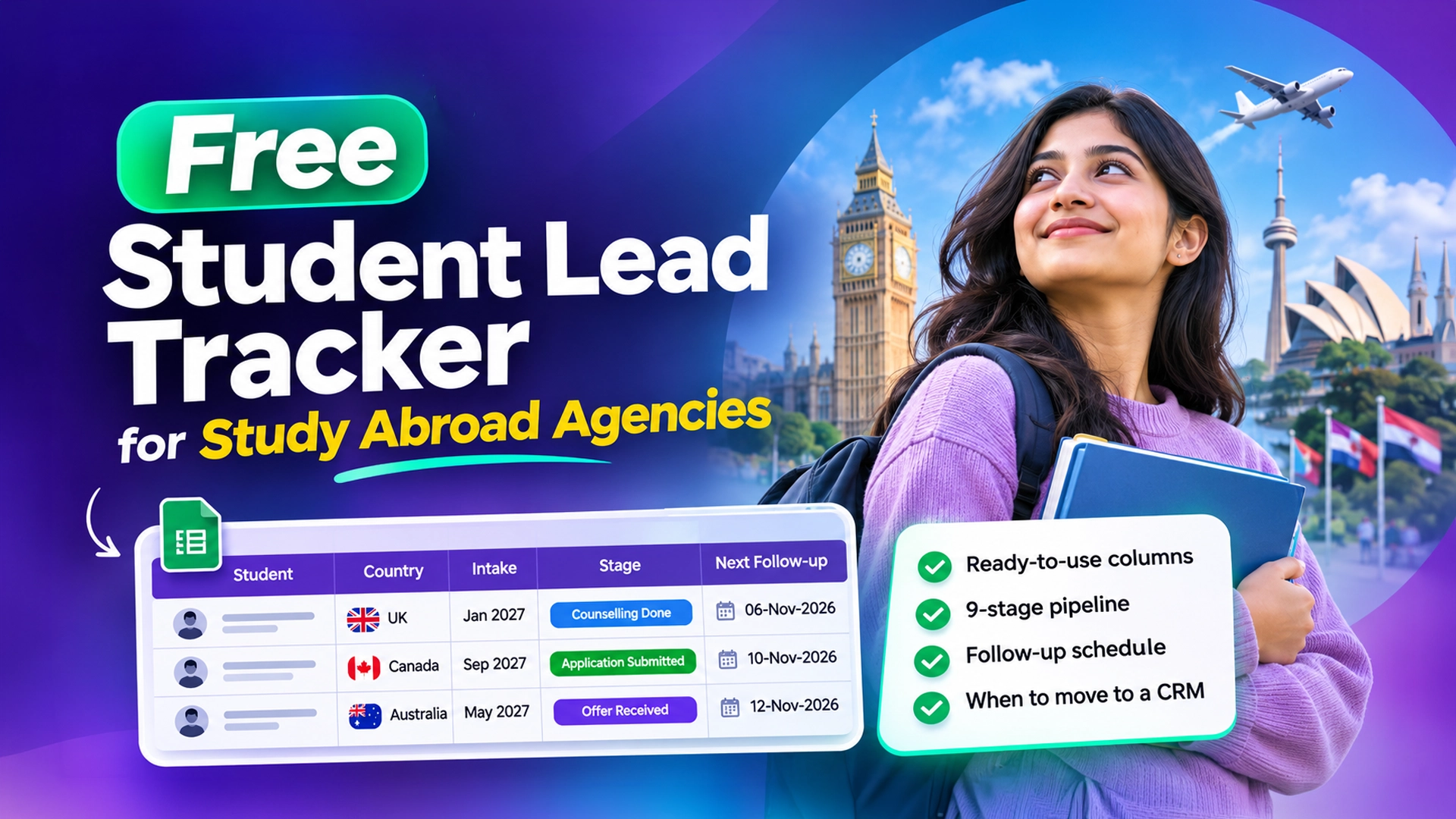
  • Free Student Lead Tracker for Study Abroad Agencies (Template)

    Free Student Lead Tracker for Study Abroad Agencies (Template)

    Last updated: 5 November 2026 · By Leads Nimble Team (a product of Luminous Labs, Dhaka)

    A study abroad CRM can start as a free student lead tracker: one spreadsheet row per student, with country, intake, IELTS score, budget, stage and next follow-up date. This guide gives you the exact columns, stages and follow-up schedule Bangladeshi agencies can copy today, and shows when to move to a real CRM.

    Key takeaways

    • One row per student, one owner per student, one “next follow-up date” per row. Without these three, any tracker fails.
    • Use 9 fixed stages from “New inquiry” to “Visa granted / Enrolled”. Dropdowns only, no free typing.
    • Track the facts that decide eligibility early: target country, intake, IELTS/PTE score, last degree, CGPA and budget.
    • Reply to new inquiries within the hour. Published research shows interest fades fast after that.
    • Outgrow the sheet when leads come from several Facebook pages, WhatsApp numbers and counsellors at once.

    What is a student lead tracker?

    A student lead tracker is a shared list of every prospective student who contacts your agency, with their profile, stage and next action. It turns scattered Messenger chats, WhatsApp threads and walk-in notes into one view.

    A study abroad CRM is software that does the same job automatically. It captures inquiries from ads and chats, stores the full conversation history, assigns counsellors and reminds them to follow up.

    Most agencies in Dhaka, Chattogram and Sylhet start with the first and move to the second. That’s a sensible path, if the tracker is built well.

    Which columns should a study abroad lead tracker have?

    Create these columns in Google Sheets or Excel. Keep the order. Columns A–H are filled at first contact; the rest are filled during counselling.

    ColColumn nameTypeExample
    ALead IDAuto numberSTU-0142
    BDate of inquiryDate03-Nov-2026
    CStudent nameTextRafiul Islam
    DPhone / WhatsAppText+8801XXXXXXXXX
    ESourceDropdownFacebook ad, Messenger, WhatsApp, Walk-in, Referral, Seminar, Website
    FAd / campaign nameTextUK Jan Intake – Nov Ad 2
    GTarget countryDropdownUK, Canada, Australia, USA, Malaysia, Germany, Other
    HTarget intakeDropdownJan 2027, May 2027, Sep 2027
    IStudy levelDropdownFoundation, Bachelor’s, Master’s, PhD, Diploma
    JSubject of interestTextMSc Data Science
    KLast degree + resultTextBSc CSE, CGPA 3.45
    LEnglish test + scoreTextIELTS 6.5 (no band below 6.0)
    MBudget (BDT, per year)Number2,500,000
    NStageDropdownSee stages below
    OCounsellorDropdownNusrat, Tanvir, Mitu
    PLast contact dateDate04-Nov-2026
    QNext follow-up dateDate06-Nov-2026
    RLead scoreDropdownHot, Warm, Cold
    SLost reasonDropdownBudget, Low score, Chose other agency, Family decision, No response
    TNotesTextWants scholarship; sister in Manchester

    Two tips save hours later. Write the English test score with the lowest band, because many universities and visa rules check each band, not only the overall score. And keep budget in Taka per year, since that’s how families in Bangladesh talk about it.

    Useful formulas for the sheet

    • Overdue follow-ups: in a helper column, =IF(AND(Q2<>"",Q2<TODAY(),N2<>"Lost",N2<>"Enrolled"),"OVERDUE",""). Then filter or colour these rows red.
    • Leads per stage: =COUNTIF(N:N,"Application submitted").
    • Leads per source: =COUNTIF(E:E,"Facebook ad"). This tells you which channel actually brings students.
    • Days since inquiry: =TODAY()-B2.

    For a full walkthrough of dropdowns and conditional formatting, see our free Google Sheets CRM template guide.

    What stages should a study abroad pipeline have?

    A pipeline stage is a fixed step that every student passes through on the way to enrolment. Fixed stages let you see where students get stuck.

    #StageExit rule (move on when…)
    1New inquiryFirst reply sent and basic profile collected
    2Profile assessedCounsellor confirms eligibility for at least one country
    3Counselling bookedOffice or video session date is set
    4Counselling doneShortlist of universities shared
    5Documents collectingTranscripts, passport, test score, SOP, references received
    6Application submittedUniversity application confirmation received
    7Offer receivedConditional or unconditional offer in hand
    8Visa filedDeposit paid and visa application lodged
    9Visa granted / EnrolledVisa approved and student travels

    Add “Lost” and “On hold (next intake)” as separate statuses. Students who miss January often come back for September. Don’t delete them.

    How fast should you follow up with a student lead?

    As fast as you can, ideally within the hour. A study published in Harvard Business Review found that firms contacting online leads within an hour were nearly seven times more likely to qualify them than firms that waited an hour longer.

    For study abroad, speed matters even more. A student who messages at 11 pm after seeing your ad has usually messaged two other agencies too. The first agency that answers the real questions (cost, scholarship, IELTS needed) often wins the counselling session.

    We looked at what slow replies cost education businesses in how slow replies cost course enrolments.

    A simple follow-up cadence

    Use this schedule for students who have not booked counselling yet. Stop once they book or say no.

    1. Day 0 (within 1 hour): Answer their question. Ask for country, intake, last result and English score.
    2. Day 1: Send a short eligibility summary and two university options in their budget.
    3. Day 3: Offer a free counselling slot (office or video). Share the date options.
    4. Day 7: Share something useful: scholarship deadline, intake deadline or a seminar invite.
    5. Day 14: Ask one direct question: “Are you still planning for the January intake?”
    6. Day 30: Move to “On hold” and add them to your next-intake broadcast list.

    After counselling, follow up on documents every 3–4 days. Students rarely say no. They just go quiet while waiting for a transcript or a bank statement.

    How to qualify a student lead in five questions

    Ask these early, in Bangla or English, whichever the student uses. They decide whether a lead is hot, warm or cold.

    1. Which country and intake are you planning for?
    2. What is your last degree and result (GPA/CGPA)?
    3. Have you taken IELTS, PTE or Duolingo? What score, and lowest band?
    4. What is your family’s yearly budget for tuition and living costs?
    5. Do you have any gap years or a previous visa refusal?

    English requirements vary by course and country, so always check the university page and the visa rules. The UK, for example, publishes its Student visa English language rules on GOV.UK. For test formats and scoring, refer students to the official IELTS website.

    Spreadsheet tracker vs study abroad CRM: which do you need?

    NeedFree tracker (Sheets/Excel)Study abroad CRM
    CostFreeFree plan or monthly fee
    Capturing leads from ads and chatsManual copy-pasteAutomatic
    Conversation historyNot storedFull chat history per student
    Follow-up remindersFormula + disciplineAutomatic tasks and alerts
    Counsellor assignmentDropdown, easy to clashRouting rules and permissions
    Which ad produced the studentOnly if typed inTracked per lead
    Night and weekend repliesNoneAI assistant can answer 24/7

    A sheet works well for a small agency with one or two counsellors and a few dozen inquiries a month. Signs you’ve outgrown it are in our free vs paid CRM checklist.

    How Leads Nimble handles student leads

    Leads Nimble is an AI sales CRM and unified inbox built in Dhaka. It pulls inquiries from Facebook Lead Ads, Messenger, Instagram, WhatsApp, website chat and Telegram into one pipeline. You can set the same stages and fields shown above.

    The AI assistant is trained on your own knowledge base: countries, tuition ranges, intake dates, IELTS needs and your office address. It answers common questions in Bangla and English at any hour, collects the five qualifying answers, and hands the student to a counsellor.

    Counsellors get follow-up reminders, the full chat history, and meeting booking synced with Google Calendar, Zoom or Calendly. You can also see which ad produced each student. See how agencies use it on our industries page and the full guide to study abroad CRM in Bangladesh.

    Start with the free forever plan (one user, one Messenger page, 500 AI credits a month) on the pricing page, or book a demo to see a study abroad pipeline set up live.

    Frequently asked questions

    What is the best free study abroad CRM?

    For very small agencies, a well-built Google Sheets tracker is the best free starting point. It costs nothing and everyone knows how to use it. When leads come from several channels, free CRM plans such as HubSpot, Zoho or the Leads Nimble free plan are the next step. Pick one that captures Messenger and WhatsApp chats, since most Bangladeshi students contact agencies there.

    Which fields matter most in a student lead tracker?

    The fields that decide eligibility and next action: target country, intake, study level, last degree and result, English test score with lowest band, budget in BDT, stage, counsellor and next follow-up date. Source and ad name are also important, because they show which marketing actually brings enrolled students rather than just inquiries.

    How often should a counsellor follow up with a student?

    Reply to a new inquiry within an hour. Then follow up on day 1, day 3, day 7 and day 14 until the student books counselling or declines. After counselling, check on documents every three to four days. At day 30 with no response, mark the lead “On hold” and add it to your next-intake list instead of deleting it.

    How many stages should a study abroad pipeline have?

    Around eight to ten. A practical set is: new inquiry, profile assessed, counselling booked, counselling done, documents collecting, application submitted, offer received, visa filed and visa granted or enrolled. Add “Lost” and “On hold” as statuses. Each stage needs a clear exit rule so counsellors move students consistently.

    Can AI answer student inquiries in Bangla?

    Yes. Leads Nimble’s AI assistant replies in Bangla and English using the knowledge base you provide, such as countries, tuition ranges, intakes and test requirements. It is best used for first answers and qualifying questions. Visa advice, scholarship decisions and anything outside your knowledge base should be handed to a human counsellor.

    When should an agency move from a spreadsheet to a CRM?

    Move when follow-ups slip, two counsellors contact the same student, or you can’t tell which ad produced which enrolment. Another clear sign is leads arriving through several Facebook pages and WhatsApp numbers that someone has to copy into the sheet by hand. At that point manual entry costs more than a CRM.
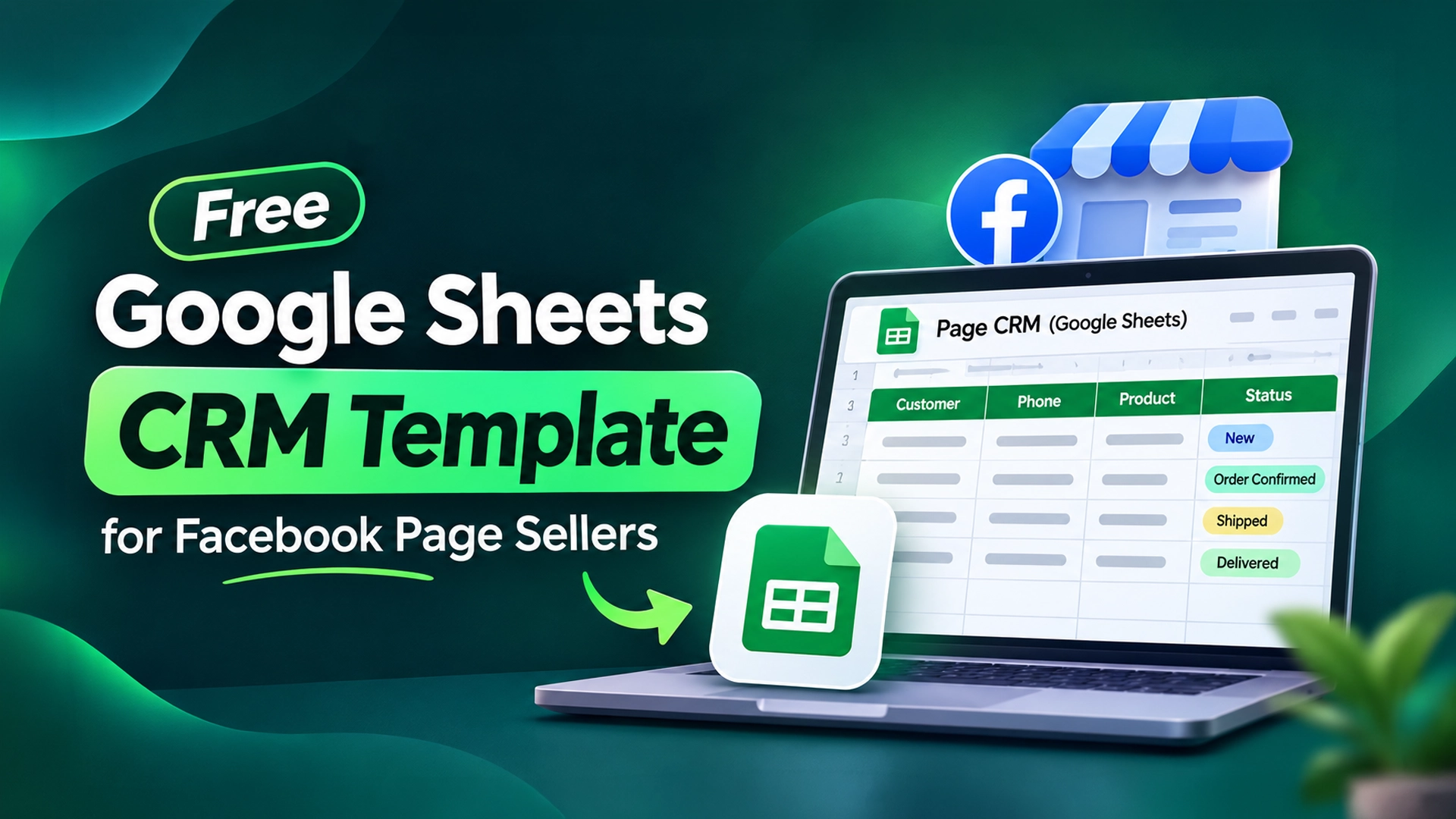

  • Free Google Sheets CRM Template for Facebook Page Sellers

    Free Google Sheets CRM Template for Facebook Page Sellers

    Last updated: 5 November 2026 · By Leads Nimble Team (a product of Luminous Labs, Dhaka)

    A free CRM template in Google Sheets is a shared spreadsheet with fixed columns, dropdowns and formulas that track every Facebook page customer from first message to delivery. Below is the exact layout we recommend for Bangladeshi page sellers: 21 columns, a Settings tab, a Dashboard with COUNTIF formulas, and follow-up alerts. It takes about 20 minutes to build.

    Key takeaways

    • Use three tabs: Leads, Settings and Dashboard.
    • Dropdowns for Channel, Status, Payment, Area and Courier keep data clean and countable.
    • A “Follow-up due” formula plus red highlighting tells you who to message today.
    • COUNTIF and SUMIFS turn the sheet into a simple sales report: orders, COD pending, leads by channel.
    • Move to a real CRM when chats come from several channels, or more than two people edit the sheet daily.

    What is a Google Sheets CRM template?

    A Google Sheets CRM is a spreadsheet used as a customer relationship management system. Each row is one lead or order, each column is one fact about it, and dropdowns control the values.

    For a small Facebook page, this is often the best first step. It is free, works on phone and laptop, and the whole team can edit it at once.

    It is not automatic, though. Someone still has to copy each customer from Messenger or WhatsApp into the sheet. Keep that in mind; we will come back to it.

    Free CRM template layout: the exact columns

    Create a new Google Sheet and rename the first tab to Leads. Type these headers in row 1, from column A to U.

    ColumnHeaderType / ruleExample
    ALead IDFormula (auto)LN-0042
    BDateDate of first message05/11/2026
    CCustomer nameTextNusrat Jahan
    DPhonePlain text, 11 digits01712xxxxxx
    EChannelDropdownMessenger
    FSource post / adTextEid kurti boost
    GProduct / codeTextKT-118
    HSize / variantTextM, Maroon
    IQtyNumber2
    JUnit price (BDT)Number1,250
    KDelivery areaDropdownOutside Dhaka
    LDelivery chargeFormula (auto)From Settings tab
    MTotal (BDT)Formula (auto)Qty × price + delivery
    NPaymentDropdownCOD
    OStatusDropdownOrder confirmed
    PCourierDropdownSteadfast
    QConsignment IDTextFrom courier panel
    RNext follow-upDate07/11/2026
    SOwnerDropdown (team names)Rafi
    TNotesTextWants gift wrap
    UFollow-up due?Formula (auto)DUE

    Select row 1 and choose View → Freeze → 1 row so headers stay visible while you scroll.

    Why format the Phone column as plain text?

    Bangladeshi mobile numbers start with 0, such as 017, 018 or 019. Sheets drops the leading zero if the column is a number.

    Select column D, then Format → Number → Plain text. Now 01712345678 stays exactly as typed.

    How to add dropdowns to your CRM template

    Dropdowns make every status countable. “Confirmed”, “confirm” and “CONFIRMED” become one value.

    First, add a second tab called Settings. Put each list in its own column:

    Settings columnList nameValues (edit to fit your business)
    AChannelMessenger, WhatsApp, Instagram, Page comment, Phone call, Website
    BStatusNew, Price asked, Interested, Order confirmed, Shipped, Delivered, Returned, Lost
    CPaymentCOD, bKash, Nagad, Bank, Card
    DDelivery areaInside Dhaka, Dhaka suburbs, Outside Dhaka
    EDelivery chargeYour charge for each area, in the same order as column D
    FCourierPathao, Steadfast, RedX, Own rider, Other
    GOwnerNames of the people who reply to customers

    Put the header in row 1 and values from row 2 down. Then follow these steps for each dropdown column on the Leads tab:

    1. Select the column range, for example E2:E1000 for Channel.
    2. Click Data → Data validation → Add rule.
    3. Under Criteria, choose Dropdown (from a range).
    4. Enter the range, for example Settings!A2:A20.
    5. Under Advanced options, choose Reject the input so nobody types a free-text status.
    6. Click Done. Repeat for K (Settings!D2:D20), N (C2:C20), O (B2:B20), P (F2:F20) and S (G2:G20).

    Google explains each option in its help article on creating an in-cell dropdown list.

    Formulas for the CRM template (copy-paste)

    Enter each formula in row 2, then drag it down to row 1000. Blank-row checks keep empty rows clean.

    Auto Lead ID (column A)

    =IF(C2="","","LN-"&TEXT(ROW()-1,"0000"))

    This creates LN-0001, LN-0002 and so on as soon as you type a name. Do not sort rows if you need IDs to stay fixed; use filters instead.

    Delivery charge from area (column L)

    =IF(K2="","",IFERROR(INDEX(Settings!$E$2:$E$20,MATCH(K2,Settings!$D$2:$D$20,0)),""))

    Change a charge once in Settings, and every new row uses the new amount.

    Order total (column M)

    =IF(OR(I2="",J2=""),"",I2*J2+N(L2))

    Follow-up due flag (column U)

    =IF(AND(R2<>"",R2<=TODAY(),O2<>"Delivered",O2<>"Lost",O2<>"Returned"),"DUE","")

    Any open lead whose follow-up date is today or earlier shows “DUE”.

    Highlight due follow-ups and duplicate phones

    Select A2:U1000 and open Format → Conditional formatting. Choose Custom formula is and enter:

    • =$U2="DUE" with a light red fill, for overdue follow-ups.
    • =AND($D2<>"",COUNTIF($D$2:$D,$D2)>1) with a yellow fill, for repeat customers or double entries.

    Google’s guide to conditional formatting rules shows where each setting sits.

    Phone number check

    Add a data validation rule on D2:D1000 with Custom formula is:

    =AND(LEN(D2)=11,LEFT(D2,2)="01")

    This catches numbers with a missing digit before the courier calls a wrong number.

    How to build the Dashboard tab with COUNTIF

    Add a third tab called Dashboard. Type the labels in column A and the formulas in column B.

    MetricFormula
    Total leads=COUNTA(Leads!C2:C)
    New leads today=COUNTIF(Leads!B2:B,TODAY())
    Orders confirmed=COUNTIF(Leads!O2:O,"Order confirmed")
    Delivered=COUNTIF(Leads!O2:O,"Delivered")
    Lead-to-delivery rate=IFERROR(B5/B2,0) (format as %)
    Follow-ups due now=COUNTIF(Leads!U2:U,"DUE")
    Delivered revenue (BDT)=SUMIF(Leads!O2:O,"Delivered",Leads!M2:M)
    COD still with courier (BDT)=SUMIFS(Leads!M2:M,Leads!O2:O,"Shipped",Leads!N2:N,"COD")
    Leads from Messenger=COUNTIF(Leads!E2:E,"Messenger")
    Leads from WhatsApp=COUNTIF(Leads!E2:E,"WhatsApp")
    Returns=COUNTIF(Leads!O2:O,"Returned")

    The formulas assume the labels start in A2 and follow the table order, so “Total leads” is B2 and “Delivered” is B5. Adjust references if you change the order. The COUNTIF help page explains the syntax.

    How to copy and share the template with your team

    1. Build it once using the steps above, then add two or three test rows to check the formulas.
    2. Delete the test rows but keep the formulas in columns A, L, M and U.
    3. Make a master copy. Use File → Make a copy and name it “CRM Template – Master”. Never type real leads into the master.
    4. Share the working copy with your team using Share → Editor. Give view-only access to anyone who just needs reports.
    5. Protect formula columns. Right-click column A → View more column actions → Protect range, so nobody overwrites a formula by mistake.
    6. Start a fresh copy for each new page or each year, so the sheet stays fast.

    Daily routine: how to use the sheet

    • Morning: filter column U for “DUE” and message those customers first.
    • Every new chat: add a row with name, phone, channel and product. Set status to “New” or “Price asked”.
    • After confirming: change status, add courier and consignment ID.
    • Evening: check the Dashboard for COD still with the courier and returns.

    Google Sheets CRM vs a real CRM: when do you outgrow it?

    Sheets is a great start. But the copy-paste step does not scale.

    TaskGoogle Sheets templateChat-based CRM (e.g. Leads Nimble)
    Capture new Messenger leadManual copyAutomatic from the inbox
    Reply to the customerSwitch to Messenger appReply from the same screen; AI can answer 24/7
    Know which ad brought the leadTyped by hand, often skippedCampaign/ad attribution
    Follow-up reminderFormula + someone checkingReminders and tasks
    Several channelsOne “Channel” dropdownMessenger, WhatsApp, Instagram, web chat, Telegram in one inbox
    Team rolesEveryone edits everythingRoles and permissions
    CostFreeFree plan; paid plans in Taka

    Signs you have outgrown the sheet:

    • You spend more than an hour a day copying chats into rows.
    • Two people answer the same customer, or nobody does.
    • Leads from WhatsApp never reach the sheet.
    • The sheet takes seconds to load on a phone.

    Read the full checklist in free vs paid CRM: 7 signs you’ve outgrown Excel, or compare options in our guide to the best free CRM software in Bangladesh.

    Next step: automate the copy-paste

    Leads Nimble turns every Messenger chat into a lead in a visual pipeline, so the sheet fills itself. Its AI assistant replies in Bangla and English, and it can still sync with Google Sheets if your team likes the spreadsheet view.

    The Free plan includes 1 user, one Messenger page and 500 AI credits a month, with no credit card. See all features or book a demo.

    Frequently asked questions

    Is there a free CRM template for Google Sheets?

    Yes. You can build one in about 20 minutes with the layout in this guide: a Leads tab with 21 columns, a Settings tab for dropdown lists and a Dashboard tab with COUNTIF formulas. It costs nothing beyond a Google account. Make a master copy first so you can reuse the clean template for other pages.

    Which columns should a CRM sheet have for a Facebook page?

    At minimum: date, customer name, phone, channel, product, price, delivery area, delivery charge, total, payment method, status, courier, consignment ID, next follow-up date and owner. Add the source post or ad if you run boosts, so you can see which posts actually bring orders.

    How do I stop Google Sheets removing the 0 from phone numbers?

    Select the phone column and choose Format → Number → Plain text before typing. Bangladeshi numbers then keep their leading 0. You can add a data validation rule with the formula =AND(LEN(D2)=11,LEFT(D2,2)=”01″) to catch numbers with missing digits.

    How do I count orders by status in Google Sheets?

    Use COUNTIF on the status column. For example, =COUNTIF(Leads!O2:O,”Order confirmed”) counts confirmed orders. For two conditions, such as shipped COD orders, use SUMIFS or COUNTIFS. Dropdowns keep spelling identical, which is what makes these formulas accurate.

    Can several people use the same Google Sheets CRM?

    Yes. Share the sheet with Editor access and everyone sees changes live. Protect formula columns so nobody deletes them, and add an Owner column so each lead has one person responsible. With more than two or three active editors, conflicts and double replies become common.

    When should I move from a spreadsheet to a CRM?

    Move when copying chats takes too much time, when leads come from several channels, or when follow-ups are missed. A chat-based CRM such as Leads Nimble captures Messenger leads automatically, reminds you to follow up and shows which ad brought each customer. Its Free plan is a low-risk way to test.